Solenis, backed by Platinum Equity, owns HTH pool chemicals and markets the US retail line through Innovative Water Care, LLC (Data as of 2026-11). Older buckets or Safety Data Sheets (SDSs) often list Arch Chemicals, Lonza, or Sigura because the brand changed corporate owners several times. Below, you can trace the 1928–2026 timeline, map HTH's five US retail categories, decode EPA container numbers, and open category guides.
- Parent company: Platinum Equity acquired Solenis and merged it with Sigura Water on November 9, 2021.
- US legal entity: Official US HTH website legal notices identify Innovative Water Care, LLC (Data as of 2026-11).
- Why old labels differ: The pool chemical unit went through 3 corporate name changes between 2018 and 2021.
- Catalog reality: One HTH logo covers both stabilized trichlor tablets and unstabilized cal-hypo products. Always check each container label.
Who Owns and Makes HTH Pool Chemicals Today—and Why Old Labels Show Different Names
When store buyers search who makes HTH pool chemicals for vendor setup or counter questions, two company names appear right away: Solenis and Innovative Water Care, LLC. Both point to the same corporate parent as of November 2026.
Current Owner and US Operating Legal Entity (Data as of 2026-11)
According to Platinum Equity's November 9, 2021 closing release, Platinum Equity acquired Wilmington, Delaware-based Solenis and merged it with Alpharetta, Georgia-based Sigura Water in a deal valued at about $6.5 billion. On its live US Residential Pool & Spa Care portfolio page (Data as of 2026-11), Solenis lists HTH Pool & Spa Care Solutions alongside Poolife, GLB, Leisure Time, POOL Breeze, PristineBlue, and Sirona.
The official US website footer on hthpools.com (Data as of 2026-11) lists Innovative Water Care, LLC as the trademark and copyright holder. Innovative Water Care, LLC operates as Solenis's legal entity for US Pool Solutions. HTH's US consumer helpline at (866)-HTH-POOL, live chat, and myHTH FAQ run under that same entity.
Corporate ownership does not mean every HTH container ships from a single plant. Service Industry News reported in December 2021 that the combined Solenis and Sigura company operated 47 manufacturing facilities across 120 countries with over 6,000 employees across all segments. Arch Chemicals' SEC Form 10-K also confirms the business long sold pool chemicals under private-label brands alongside HTH, Pulsar, and POOLIFE 14.
Solenis does not publish a retail-SKU-by-plant directory. To verify the physical facility behind a specific sanitizer container, check the EPA Establishment Number on the bucket. You can also explore our Brands and Alternatives hub to place HTH alongside other US retail brands.
HTH Corporate Ownership Timeline: 1928 to Solenis
Old buckets in a customer's shed, archived SDS binders, and older forum posts often cite Olin, Arch Chemicals, Lonza, or Sigura. Use the table below to match any legacy company name to current Solenis ownership (Data as of 2026-11).
| Period / Date | Brand Owner or Operating Entity | Verified Milestone | Source Context |
|---|---|---|---|
| 1928 | HTH brand launch | HTH Pool & Spa Care water products introduced | HTH official US brand page (2026-11) |
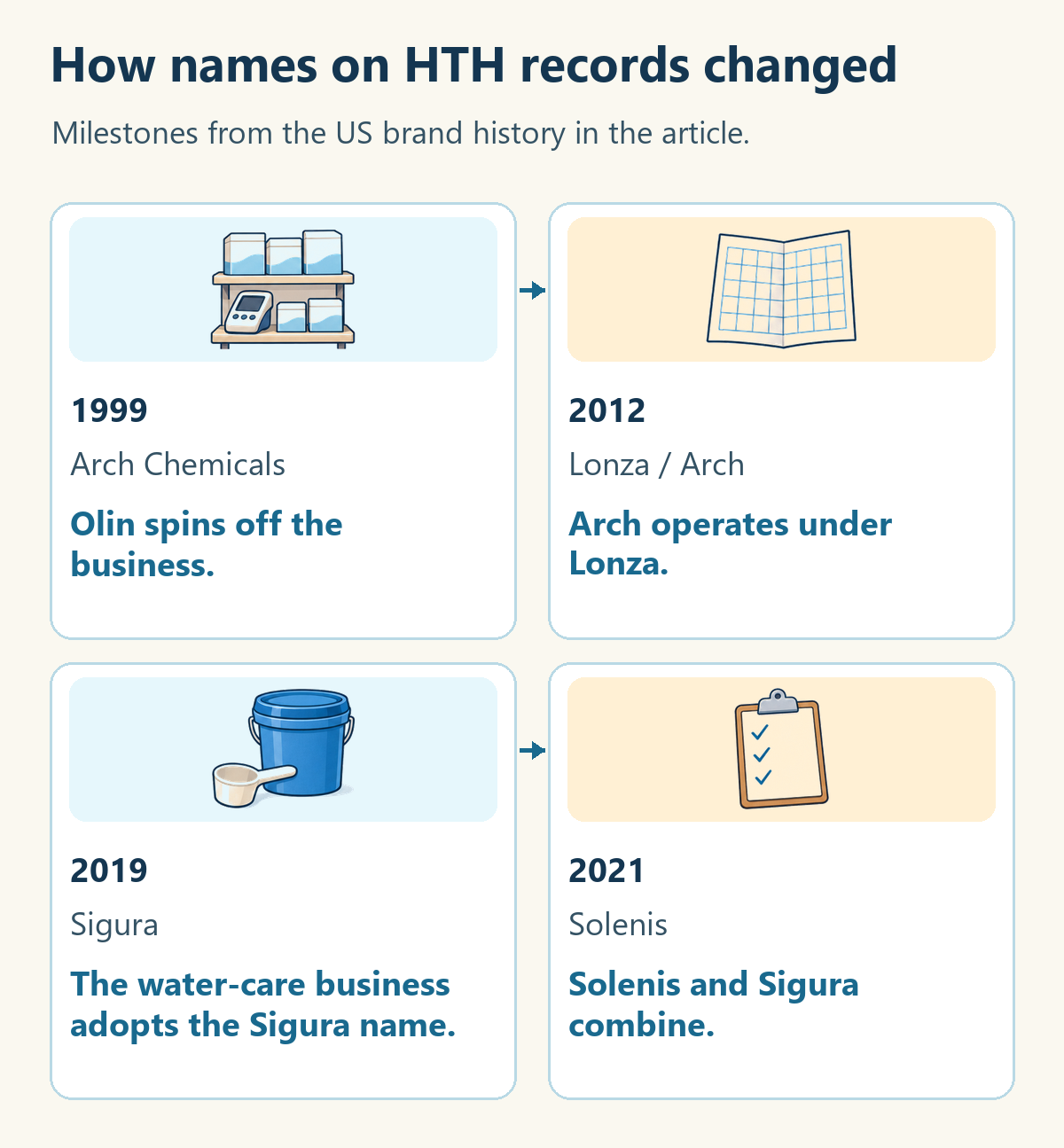
| Feb 8, 1999 | Arch Chemicals, Inc. | Olin Corporation spun off HTH, Baquacil, Pulsar, and POOLIFE 14 | U.S. SEC Form 10-K (filed March 14, 2005) |
| Sept 2012 | Lonza Group (Arch Chemicals) | Arch Chemicals operated under Lonza Group marketing HTH | EuroSpaPoolNews (Sept 20, 2012) |
| 2018–2019 | Innovative Water Solutions to Sigura | Lonza unit became Innovative Water Solutions, then Sigura in 2019 | Aquatics International (Nov 2021) |
| Nov 9, 2021 | Solenis (Platinum Equity) | Platinum Equity merged Solenis and Sigura (about $6.5 billion) | Platinum Equity / PR Newswire (Nov 9, 2021) |
| Data as of 2026-11 | Solenis / Innovative Water Care, LLC | Active US Residential portfolio & website copyright entity | Solenis & HTH official US sites (2026-11) |
The 2018–2021 stretch creates most buyer confusion. As Aquatics International reported in November 2021, the Alpharetta pool unit went through 3 corporate name changes in 3 years: it operated as Lonza in 2018, became Innovative Water Solutions, switched to Sigura in 2019, and merged into Solenis in 2021.
That sequence explains why older SDS files still name Arch Chemicals, Lonza, or Sigura. One terminology detail also matters: NOAA's CAMEO Chemicals database lists HTH and HTH DRY CHLORINE as trade-name aliases for dry calcium hypochlorite 1. Even with that cal-hypo heritage, modern HTH shelves span multiple chemical classes.
Counter Check: Legacy invoices, SDSs, or buckets naming Arch Chemicals, Lonza, Sigura, or Innovative Water Care, LLC all trace to HTH's verified lineage under Solenis (Data as of 2026-11). Pull a current Innovative Water Care, LLC SDS before onboarding any SKU.
HTH's US Retail Product Lineup: Five Core Categories and Their Chemistries
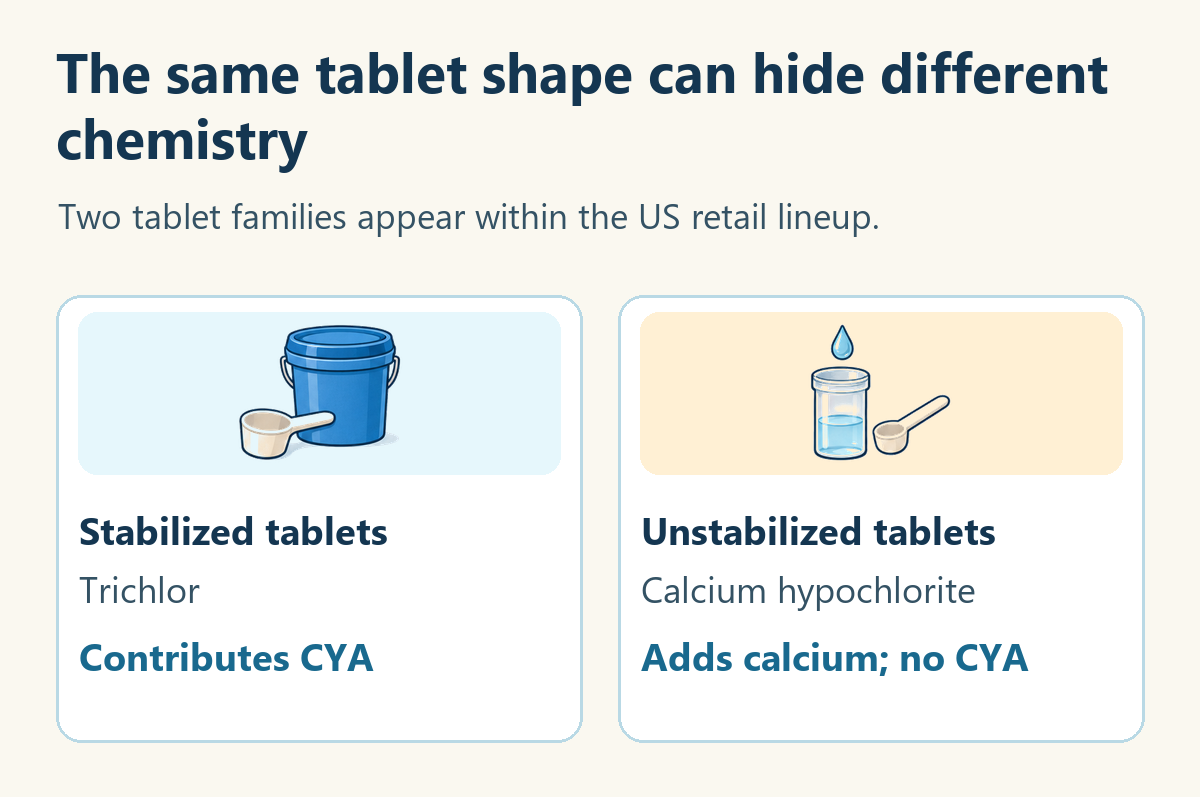
HTH's US retail catalog covers five core categories (Data as of 2026-11): calcium hypochlorite shocks, chlorine tablets (in both stabilized trichlor and unstabilized cal-hypo formats), water balancers, algaecides and specialty treatments, and 6-Way test strips paired with the Test to Swim app.
Keep three chemical terms straight before reading a container panel:
- Calcium hypochlorite (cal-hypo): An unstabilized dry chlorine sanitizer offering 47–78% available chlorine that raises pool pH and adds zero stabilizer 9.
- Trichlor (trichloroisocyanuric acid): A slow-dissolving stabilized chlorine tablet chemistry with 90% available chlorine that lowers pH and adds stabilizer.
- Cyanuric acid (CYA): Chlorine stabilizer that shields free chlorine from sunlight but builds up in pool water over the season.
Five Core HTH US Retail Categories at a Glance
Use this chemistry map to connect HTH's five retail categories to their active ingredients, CYA impact, and pH effects (Data as of 2026-11). Chlorine Tablets appear as two sub-rows below because HTH sells two incompatible tablet chemistries.
| Retail Category | Representative US HTH Products | Core Active Chemistry | Stabilizer (CYA) Effect | pH Direction |
|---|---|---|---|---|
| Granular Shock | Shock Advanced (cal-hypo line) | Calcium hypochlorite (class range: 47–78% avail. Cl) 9 | Adds 0% CYA | Raises pH 9 |
| Chlorine Tablets — Stabilized | Standard 3-inch Chlorine Tablets | Trichlor (90% avail. Cl) 9 | About 57% CYA by weight | Lowers pH 9 |
| Chlorine Tablets — Unstabilized | Brilliance Cal Hypo Chlorine Tablets | Calcium hypochlorite (class range: 47–78% avail. Cl) 9 | Adds 0% CYA | Raises pH 9 |
| Water Balancers | pH Up, pH Down, Alkalinity Up, Calcium Hardness Up, Stabilizer | Non-sanitizer pH, alkalinity, hardness, and CYA adjusters | Stabilizer adds CYA; others none | pH Up raises / pH Down lowers (7.2–7.6 pH target) |
| Algaecides & Specialty | Algae Guard Advanced, clarifiers, flocs | Non-foaming algaecides & clarifiers | Non-chlorine (check SKU label) | Varies by SKU |
| Water Testing | 6-Way Pool Test Strips & Test to Swim App | Colorimetric strip reagents (6 parameters) | Reads CYA 0–300 ppm | Reads pH 6.4–8.4 |
HTH's official Shock Advanced product page describes a multi-functional, fast-acting calcium hypochlorite shock formulated to control bacteria and algae while clearing cloudy water without adding cyanuric acid. For SKU-level shock differences, see our HTH Shock Ultra vs Advanced vs Super comparison.
In the balancer aisle, HTH's pH Up product page targets the 7.2–7.6 pH range and notes that total alkalinity below 80 ppm prevents pH stability. HTH's Algae Guard Advanced page lists a non-foaming algaecide for green, black, and mustard algae in vinyl-lined and saltwater pools, alongside clarifiers, flocculants, phosphate removers, and stain controls.
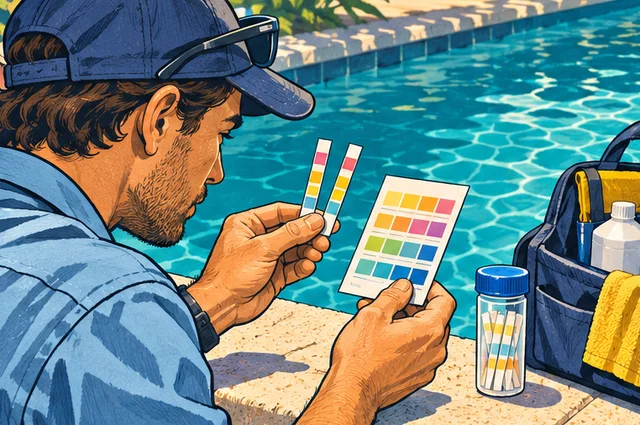
HTH's 6-Way Pool Test Strips product page states the strips measure 6 parameters: free chlorine, bromine, pH, total alkalinity, calcium hardness, and cyanuric acid, work in chlorine, bromine, and saltwater pools, and scan with the free HTH Test to Swim App. HTH's online color chart covers Free Available Chlorine 0–10 ppm, pH 6.4–8.4, Total Alkalinity 0–240 ppm, Total Hardness 0–800 ppm, and Cyanuric Acid 0–300 ppm.
Mind one storage limit on test strips. HTH notes its 6-Way Test Strips stay accurate for 12–18 months only when stored cool, dry, and tightly capped, because brief humidity degrades accuracy. For pad-by-pad reading steps, use our How to Read HTH 6-Way Test Strips guide.
Why HTH Carries Both Stabilized Trichlor and Unstabilized Cal-Hypo Tablets
Many buyers assume every HTH chlorine product uses the same chemistry. HTH's US retail catalog actually stocks two incompatible chlorine tablet types side by side (Data as of 2026-11):
- Standard HTH 3-inch Chlorine Tablets (stabilized trichlor): HTH's product page lists about 57% cyanuric acid by weight, a 1–4 ppm free chlorine target, and a starting dose of 1 tablet per 10,000 gallons per week. HTH cautions that trichlor raises CYA over the season and advises monthly CYA testing and switching away at 50 ppm.
- HTH Brilliance Cal Hypo Chlorine Tablets (unstabilized cal-hypo): HTH's product page lists 0% cyanuric acid, with each tablet treating 10,000 gallons over 5–7 days.
Dual-Tablet Contrast: Standard HTH 3-inch tablets add about 57% CYA by weight and lower pH, while HTH Brilliance Cal Hypo tablets add 0% CYA and raise pH 9. Match the tablet to your pool's CYA level and keep each chemistry in its own dedicated dispenser. For full tablet SKU details, read Do HTH Chlorine Tablets Have Stabilizer?.
With HTH's five US retail categories mapped by chemistry, the next step is verifying the federal registration and packaging codes printed on an individual container.
How to Verify Who Registered and Packaged an HTH Container Using EPA Numbers and Labels
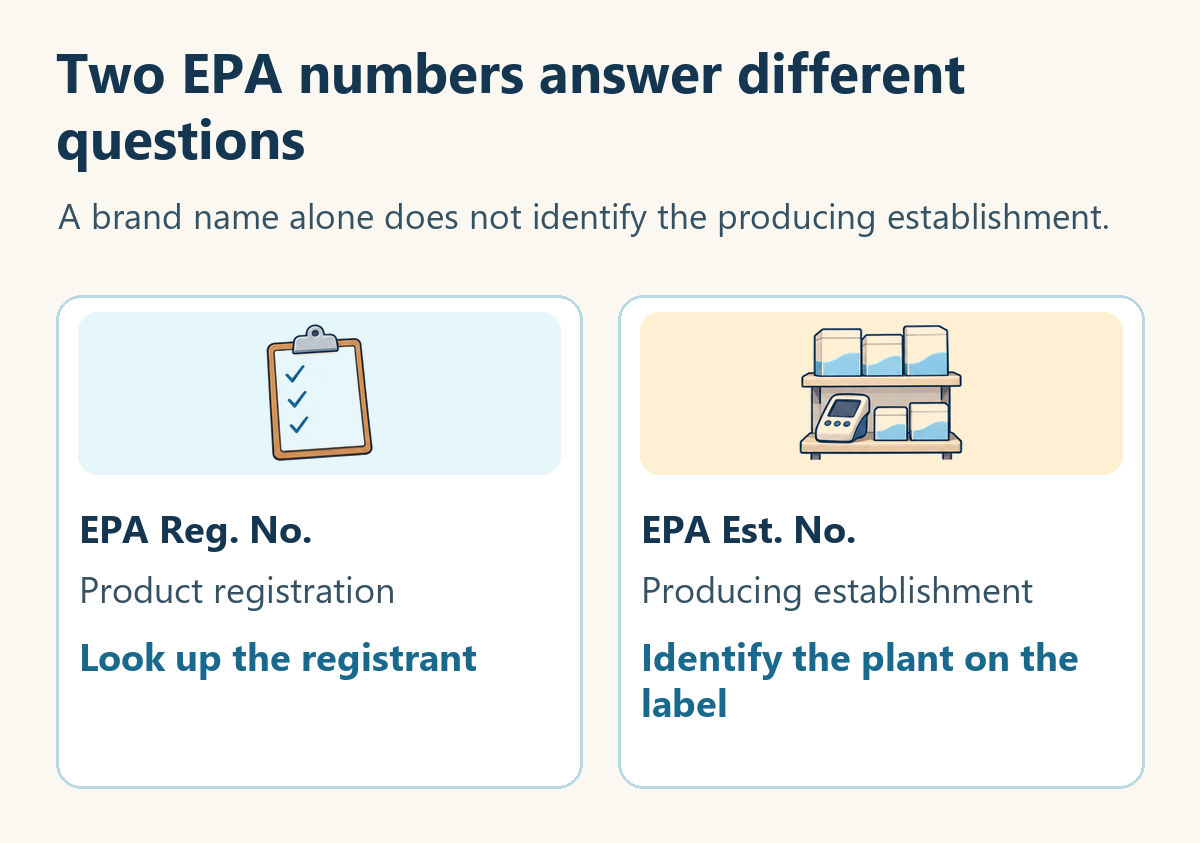
When buyers ask who actually registered or packaged a bucket of HTH, the back panel gives verifiable facts that front-label branding omits. Four label checks under US federal pesticide rules separate legal registrants, supplemental distributors, and physical packaging plants.
Which HTH Products Carry an EPA Registration Number (and Which Do Not)
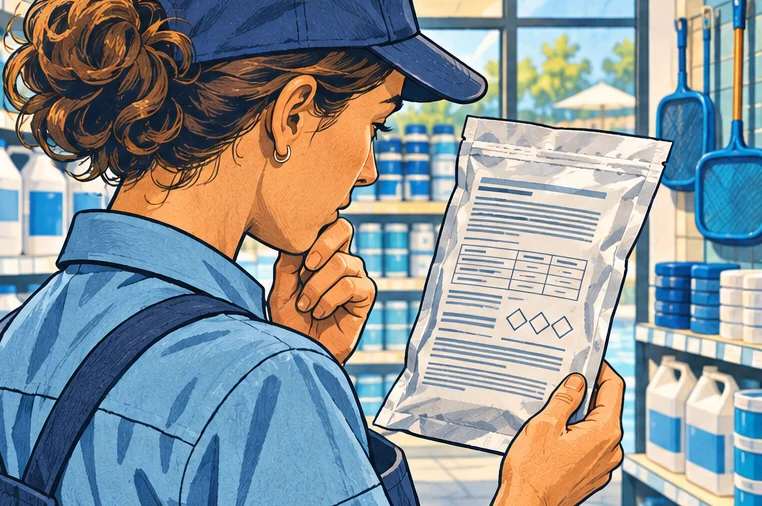
Not every HTH bottle carries an EPA number, and a missing number on a balancer is completely normal. Per the National Pesticide Information Center (NPIC), pool chemicals claiming to kill or control bacteria, algae, or pathogens are antimicrobial pesticides that must carry an EPA Registration Number (EPA Reg. No.), the federal code proving U.S. EPA registration 10.
Products making only water-balancing or clarifying claims are not antimicrobial pesticides. That is why HTH pH Up, Alkalinity Up, clarifiers, and pool test strips do not carry an EPA Reg. No. 10.
How to Read Two-Part vs. Three-Part EPA Reg. No. and EPA Est. No.
Follow four quick steps when auditing any US pool sanitizer or algaecide container:
- Confirm antimicrobial pesticide status: Check whether the label claims to sanitize, kill bacteria, or control algae. Only antimicrobial pool products require EPA registration numbers 10.
- Check the mandatory 40 CFR 156.10 label fields: Under 40 CFR 156.10, every registered pesticide label must display the product name, producer or registrant name and address, net contents, EPA Reg. No., EPA Est. No., ingredient statement, hazard statements, and directions for use in English at 6-point or larger type 4. Even with a fold-out booklet, the EPA Label Review Manual Chapter 3 requires core identification (producer name, EPA registration number, and hazard statements) directly on the container, and referenced websites or accompanying sheets count as labeling 8.
- Decode the EPA Reg. No. segments (two-part vs. three-part): The U.S. EPA Pesticide Registration Manual (Chapter 14) explains that the first segment, the EPA Company Number, identifies the basic registrant across all its registered products, followed by the product number 6. Under 40 CFR 152.132, a registrant may authorize a supplemental distributor registration—an EPA-notified private-label arrangement letting another company sell the registered product under its own brand—by adding a third segment for the distributor's company number 3.
- Verify the packaging plant with the EPA Est. No.: Look separately for the EPA Establishment Number (EPA Est. No.), the facility code showing the physical site that last produced or packaged that container. Under FIFRA Section 7 (40 CFR Part 167), any facility producing or packaging pesticides or active ingredients must hold an EPA-registered establishment number and file annual production reports, and the EPA registration manual confirms this code combines the company number with the specific plant identifier 5.
Private-Label & Non-Pesticide Boundary: Missing EPA numbers on pH balancers, clarifiers, or test strips reflect NPIC's non-pesticide boundary 10. On three-part supplemental distributor labels, the EPA Label Review Manual specifies that distributors may delete claims from the master label, cannot add new efficacy claims, and must keep mandatory directions intact 7.
For store buyers comparing a store-brand sanitizer with a national brand, matching the first two EPA Reg. No. segments shows whether both products tie back to the same basic registration. Still verify active percentages and additives on each label. Next, review two safety and commercial boundaries under the HTH umbrella.
Key Lineup Boundaries: Cal-Hypo vs. Stabilized Tablets and Retail HTH vs. Commercial Lines
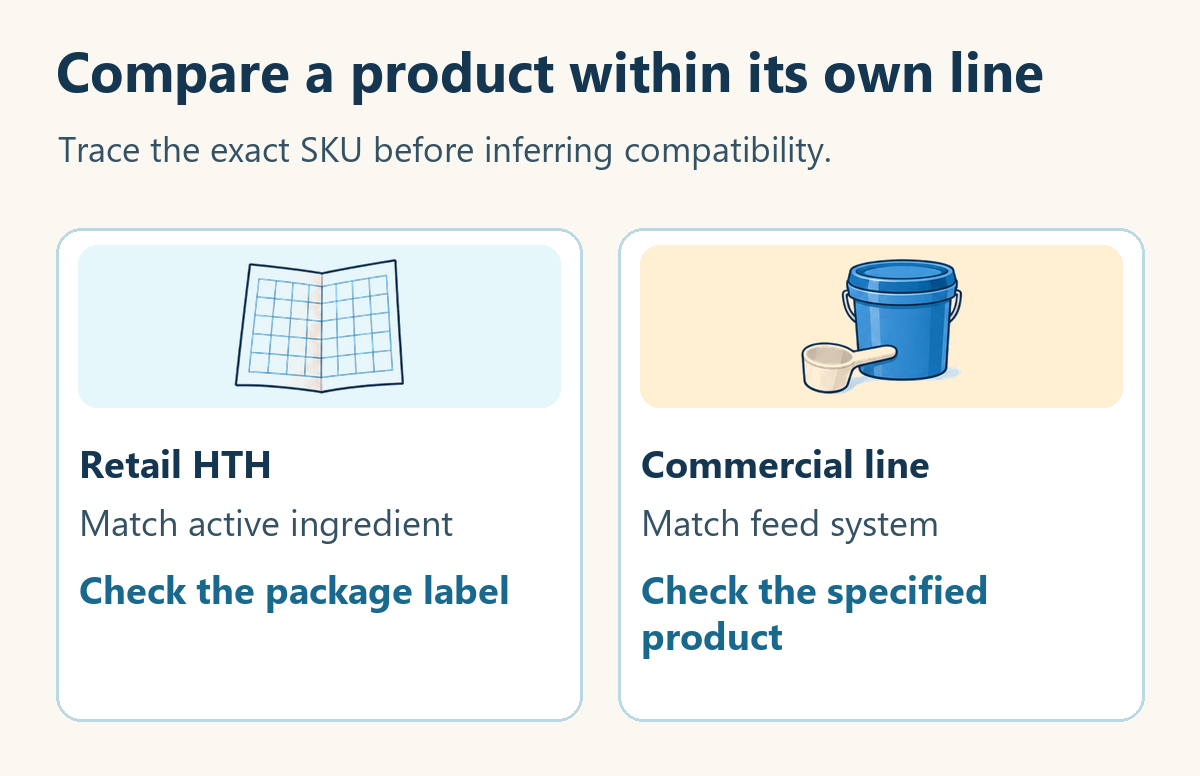
Sharing the HTH logo or the Solenis and Innovative Water Care parent company never makes two pool chemicals interchangeable. Two boundaries trip up stores and pool operators: chemical mixing hazards inside dispensers and the split between US retail HTH and Solenis commercial brands.
Never Mix Cal-Hypo and Stabilized Trichlor—Even Under the Same HTH Logo
Never mix calcium hypochlorite shocks or cal-hypo tablets with stabilized trichlor or dichlor tablets. Never load one chlorine chemistry into a feeder or floater used for the other.
NOAA CAMEO Chemicals identifies trichlor as a strong oxidizer. Keep it dry and segregated from incompatible materials.2 Use the dedicated feeder specified on the product label and follow the safety data sheet.11
The Oregon Health Authority pool manual documents typical available chlorine concentrations—trichlor at 90%, dichlor at 62%, and sodium hypochlorite at 10–12%—and warns operators never to place calcium hypochlorite in a trichlor or bromine erosion feeder 13. Because HTH stocks both standard trichlor tablets and Brilliance cal-hypo tablets, switching tablet chemistries requires a dedicated, compatible dispenser designed for that chemistry that has never held an incompatible sanitizer.
Explosion Hazard: Mixing cal-hypo with trichlor, or placing cal-hypo in a feeder holding trichlor residue, can trigger violent gas release or an explosion even when both buckets say HTH 211.
Retail HTH Pool Care vs. Solenis Commercial Brands (Pulsar and CCH) and NSF/ANSI 50
Commercial pool managers sometimes spot international brochures for HTH Pro and search for commercial HTH feeders in the United States. On its official Commercial Pool & Spa portfolio page (Data as of 2026-11), Solenis designates CCH and Pulsar as its dedicated US commercial pool brands, while using commercial HTH and HTH Pro branding in Europe, Latin America, and South Africa.
Pulsar's official homepage (pulsarpools.com, Data as of 2026-11) shows this exact corporate link. Pulsar 360 commercial systems use specialized calcium hypochlorite briquettes and commercial feed equipment, while carrying the same © 2026 Innovative Water Care, LLC trademark notice as retail HTH. Commercial briquette feeders still require their specified briquettes in place of retail granular buckets.
Commercial facilities must also verify NSF/ANSI 50 listings at the exact SKU level. NSF/ANSI 50 is the US public-health standard evaluating pool chemicals and equipment for health effects. Public NSF/ANSI 50 listings for calcium hypochlorite disinfectants specify SKU-level maximum use levels—such as 23 mg/L for HTH GRANULAR, 3.2 mg/L for certain tablets, and 4 mg/L or 30 mg/L for other listings—and certify health effects only, never sanitization performance, so one listed SKU never covers the entire HTH brand 12.
With ownership, categories, EPA numbers, and safety limits clear, you can evaluate HTH against comparable brands using verifiable label specs.
Are HTH Pool Chemicals Good? How to Compare Comparable Products—and Where to Go Next
Asking whether HTH pool chemicals are good has no single yes-or-no answer because HTH is a multi-category umbrella. While US retail shelves organize into the five core categories mapped above (with stabilizer grouped under water balancers), HTH's official US catalog FAQ lists 6 core maintenance program categories (Data as of 2026-11): sanitizer, shock, balancers, stabilizer/CYA, algaecide, and test strips or kits. Quality depends on matching each container's chemistry to your pool water.
Five Label and SDS Checkpoints to Compare HTH With Comparable Brands
Compare any HTH SKU against a comparable pool chemical using five verifiable checkpoints from mandatory 40 CFR 156.10 labels, SDSs, and public certification listings 4:
| Checkpoint | What to Read on the Container or Listing | Why It Changes Your Buying Decision |
|---|---|---|
| 1. Chemical Class & Available Cl % | Active ingredient statement under 40 CFR 156.10 4 | Cal-hypo (47–78%, raises pH), trichlor (90%, lowers pH), and dichlor (near neutral) behave differently 9 |
| 2. Stabilizer (CYA) Content | Ingredient panel & label warnings | HTH's 3-inch trichlor tabs carry about 57% CYA; cal-hypo shocks and Brilliance tabs add 0% CYA |
| 3. Multi-Action Additives | Active/other ingredients & net weight 4 | Clarifiers, algaecides, or scale blockers shift active chlorine per pound and dosing cost |
| 4. EPA Reg. No. & Est. No. | Back-panel registration & plant codes 4 | Separates basic registrants from supplemental distributors and confirms producing or packaging plant |
| 5. Commercial NSF/ANSI 50 Listing | SKU-exact NSF listing & max use level | Listed cal-hypo max use levels span 3.2–30 mg/L and certify health effects only 12 |
Apples-to-Apples Standard: Normalize comparable sanitizers by chemical class, available chlorine percentage, and CYA content using 40 CFR 156.10 label data instead of treating two brands as interchangeable or ranking one brand above another 4. Shelf prices shift by retailer and season, so calculate cost per pound of available chlorine from the container net weight and the available chlorine percentage listed on the label or SDS.
Where to Go Next in Our HTH Brand Guides
Because individual formulas vary across shocks, tablets, test strips, and saltwater pools, jump straight to the category guide matching your task:
| Your Question or Task | Dedicated PoolTradeDesk Guide |
|---|---|
| Compare HTH vs. Clorox pool shock labels, chemistry, and dosing costs | HTH vs Clorox Pool Shock |
| Compare HTH Shock Ultra, Shock Advanced, and Super Shock tiers | HTH Shock Ultra vs Advanced vs Super |
| Check which HTH chlorine tablets add stabilizer (CYA) and compare SKUs | Do HTH Chlorine Tablets Have Stabilizer? |
| Read HTH 6-Way test strip colors and translate pad readings into dosing | How to Read HTH 6-Way Test Strips |
| Choose shock chemistry and brand options for a saltwater pool | Best Pool Shock for Salt Water Pools |
| Explore other US pool chemical brands and label-matched alternatives | Brands and Alternatives |
Common Questions About HTH Ownership, Support, and Product Tools
Does HTH offer official US customer support?
Yes. Innovative Water Care, LLC operates official US consumer phone support, live chat, and an online myHTH FAQ portal through the HTH Pools website (covered in the ownership section above). If a store or pool owner needs an updated Safety Data Sheet for a bucket bearing a legacy Arch Chemicals, Lonza, or Sigura name, contacting Innovative Water Care, LLC support is the direct route.
What is the HTH Test to Swim app used for?
The free HTH Test to Swim mobile app pairs with HTH multi-parameter pool test strips so users can scan a dipped strip with a smartphone camera and get basic water-balance guidance. For reliable readings, store strips cool, dry, and tightly capped, and cross-check any major chemical adjustment against the physical color chart on the bottle.
Does HTH make spa and hot tub chemicals as well as pool chemicals?
Yes. Alongside its residential swimming pool catalog, HTH markets a dedicated spa care lineup under the same Solenis Residential Pool & Spa Care umbrella. Always check the container label to confirm whether a sanitizer or balancer is dosed for hot-water spa volumes and smaller basins.
Can you tell which specific factory made an HTH bucket?
Solenis does not publish a public plant-by-SKU manufacturing list for retail HTH containers. To verify the physical facility that last produced or packaged an EPA-registered HTH sanitizer or algaecide, read the EPA Establishment Number printed on the container back panel instead of relying on corporate headquarters addresses.
Verify the Label Behind the Brand Name Before You Stock or Dose
Knowing that Solenis owns the HTH brand and markets US retail containers through Innovative Water Care, LLC clears up why legacy buckets and older forum threads still cite Olin, Arch Chemicals, Lonza, or Sigura. Corporate lineage explains the logo, while the container label governs safe dosing and smart stocking.
Before you add an HTH SKU to a store shelf or compare it with another brand, apply three label-first rules: keep stabilized trichlor tablets completely separate from unstabilized cal-hypo shocks and tablets so incompatible chemistries never share a dispenser, use the EPA Registration and Establishment Numbers to confirm registrant and producing or packaging plant on antimicrobial products, and verify SKU-specific commercial health-effects listings whenever buying for public or hotel pools. From there, use our category guides above to compare exact shocks, tablets, test strips, and saltwater options side by side.
References
- NOAA CAMEO Chemicals — Calcium Hypochlorite Alternate Names (HTH) — 2026-09-18
- NOAA CAMEO Chemicals — Trichloroisocyanuric Acid Reactivity with Calcium Hypochlorite — 2026-09-18
- 40 CFR 152.132 — Supplemental Distribution of a Registered Pesticide (eCFR) — 2026-09-15
- 40 CFR 156.10 — Labeling Requirements for Pesticides and Devices (eCFR) — 2026-09-15
- U.S. EPA — Pesticide Establishment Registration and Reporting (FIFRA Section 7) — 2026-11-25
- U.S. EPA Pesticide Registration Manual — Chapter 14: EPA Company and Establishment Numbers — 2026-11-25
- U.S. EPA Label Review Manual — Master, Sub-Label, and Distributor Labels — 2026-09-18
- U.S. EPA Label Review Manual — Required Container Label Elements, SDS and Website Labeling — 2026-09-18
- Lake County Health Department — Pool Disinfectant Available Chlorine and pH Effects (Table 3) — 2026-09-19
- NPIC — Pool and Spa Chemicals: Antimicrobial Pesticide Registration Scope — 2026-09-18
- NSF International — Chemical Feeder and Disinfectant Mismatch Hazard — 2026-09-18
- NSF/ANSI 50 Listings — Calcium Hypochlorite Disinfectants (Including HTH Granular) — 2026-09-18
- Oregon Health Authority Pool Manual — Chlorine Types and Feeder Safety — 2026-09-19
- U.S. SEC Form 10-K — Arch Chemicals, Inc. (FY 2004, Filed March 14, 2005) — 2005-03-14
How this guide was prepared
Prepared by Martin. Based on 14 cited sources listed in References. Content date: 2026-11-25.