Use non-chlorine shock (potassium peroxymonosulfate, or MPS) strictly for preventive oxidation of bather waste when free chlorine and pH already meet local code, water is clear, and you need rapid swim re-entry, per PHTA definitions and Oxone product guidance.16 Switch to unstabilized chlorine shock for active algae, low free chlorine, fecal incidents, or verified inorganic chloramines, and test post-MPS water with a deox reagent before trusting combined-chlorine readings.419
Written for commercial facility operators, service technicians, and pool retail staff by the PoolTradeDesk editorial team (operated by our company, Kingnod), this comparison draws directly on CDC 2024 MAHC, PHTA, UK PWTAG and HSG282, LANXESS Oxone, HASA SDS, and Taylor Technologies technical documentation.
- MPS weekly dose and re-entry: LANXESS Oxone product guidance lists 1 lb per 10,000 US gallons (120 g per 10 m³) circulated 15 minutes in an unoccupied pool, provided existing free chlorine and pH already meet local code and you follow your container label.
- Chlorine shock reopening caps: EPA labels cap bather re-entry at 4 ppm in pools (5 ppm in spas), while 2024 CDC MAHC (a voluntary model code) sets a 10 ppm DPD-FC / 8.0 ppm bromine imminent-hazard closure ceiling—not a routine reopening limit.97
- DPD test bias: Any residual MPS inflates DPD #3 combined-chlorine readings, and MPS above 25 ppm also biases DPD free-chlorine readings high (2024 CDC MAHC Annex)—verify with Taylor R-0867 Deox Reagent (see DPD section below).
- Sulfate ceiling for cement and grout: UK PWTAG warns that sulfate levels above 360 mg/L pose a corrosion risk to cementitious grout and cement surfaces (see Water Balance section below).
When to Use Non-Chlorine Shock (MPS) vs. Chlorine Shock
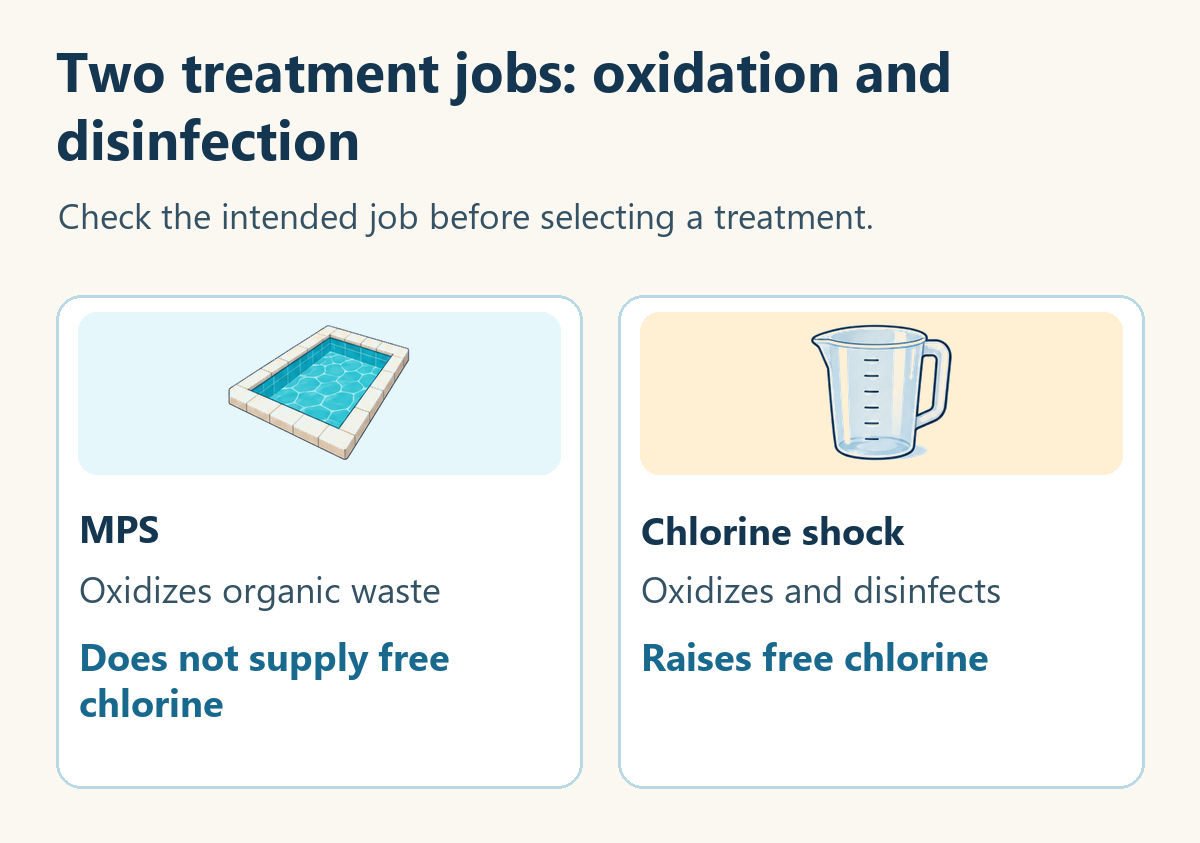
Pick your shock by the chemical job in front of you: oxidation alone or oxidation plus disinfection. Potassium peroxymonosulfate (MPS), a chlorine-free oxidizer salt sold as non-chlorine shock, breaks down organic bather waste without raising free chlorine. PHTA defines non-chlorine oxidizers as waste-oxidizing products that may not kill bacteria or algae, and the Lake County Health Department manual confirms MPS does not disinfect pool water.164
Chlorine shock—typically unstabilized liquid sodium hypochlorite or granular calcium hypochlorite—performs both jobs at once. It oxidizes organics and actively kills bacteria, algae, and protozoa, making it mandatory whenever sanitation fails or public-health response codes trigger. For broader parameter targets across our Water Chemistry library, match the shock class first before pulling a bucket off the shelf.
Pool-Condition Decision Matrix: Non-Chlorine Shock (MPS) vs. Chlorine Shock
Compare chemical role, dosing yield, swim re-entry prerequisites, low free chlorine, algae, fecal incidents, and spa microbial emergencies below to pick the right shock class.
| Pool Condition or Metric | Non-Chlorine Shock (MPS) | Chlorine Shock (Liquid / Cal-Hypo) |
|---|---|---|
| Primary Chemical Role | Preventive oxidizer only; non-sanitizing (PHTA)16 | Dual oxidizer + sanitizer/algaecide219 |
| Typical Routine Dose (per 10,000 US gal) | 1 lb (120 g per 10 m³) weekly (LANXESS Oxone) | Yield benchmark: 1 gal 12.5% liquid (~12.5 ppm); 1 lb cal-hypo (7.8–9.0 ppm) (PHTA)14 |
| Swim Re-Entry Requirement | 15 min circulation, unoccupied; existing FC & pH in code (LANXESS Oxone) | Wait until FC <=4 ppm pool / 5 ppm spa (10 ppm MAHC model-code closure cap)97 |
| Low FC or Established Inorganic Chloramines | Do not substitute; non-disinfecting4 | Mandatory unstabilized chlorine shock (see Chloramines section below) |
| Active Algae Control | May not kill algae (PHTA); hypochlorite required (PWTAG)1619 | Mandatory (10 mg/L free chlorine via hypochlorite, pH <=7.5, for 24 h, PWTAG)19 |
| Fecal / Cryptosporidium Response | Prohibited; non-disinfecting4 | Mandatory (2 ppm x 25–30 min formed; CT 15,300 at 0 ppm CYA diarrhea)2 |
| Spa Gross Microbial Contamination | Prohibited; non-disinfecting4 | Mandatory (50 mg/L FC x 1 h + drain for P. aeruginosa >50 cfu/100 mL, UK HSG282)3 |
Two matrix points matter most on commercial decks. First, MPS keeps a busy facility open only when existing sanitizer and pH already satisfy local code; it backs up an active chlorine or bromine residual rather than replacing it. Second, once you choose chlorine shock, selecting liquid sodium hypochlorite versus granular calcium hypochlorite or dichlor depends on calcium hardness, cyanuric acid (CYA) budget, and truck storage—covered in our Pool Shock Liquid vs Powder guide.
Dosage Baselines and Swim Re-Entry Prerequisites (15 Minutes vs. EPA 4 ppm / MAHC 10 ppm)
Product guidance for Oxone-based MPS—including both LANXESS's August 2024 brochure and Haviland Clear Result product literature—sets a routine preventive maintenance dose of 1 lb per 10,000 US gallons (120 g per 10 m³, or 12 g per m³). Because MPS adds zero free chlorine, LANXESS directs dispersing it into an unoccupied pool and circulating for 15 minutes before re-entry, while Haviland Clear Result directs applying unoccupied with the pump running and notes swimmer access within 15 minutes.
That 15-minute swim window is never unconditional. Apply MPS only while the pool or spa is unoccupied, keep the circulation pump running until granules fully dissolve and disperse, confirm existing sanitizer and pH already meet local health code, and verify the exact active-ingredient assay and re-entry directions printed on your specific container label.
Chlorine shock requires holding swimmers out until free chlorine falls back within statutory and label limits. Under PHTA RWQC March 2020 benchmarks, 1 gallon of 12.5% liquid chlorine adds roughly 12.5 ppm free chlorine per 10,000 US gallons, and 10.6 fl oz adds roughly 1 ppm; 1 lb of calcium hypochlorite adds 7.8 ppm at 65% strength, 8.4 ppm at 70%, or 9.0 ppm at 75%.14 For exact volume scaling across US gallons and cubic metres, use our Pool Chemical Dosage Chart.
Re-Entry Ceiling — EPA 4 ppm Label Cap vs. 2024 CDC MAHC 10 ppm Closure Limit: Under 2024 CDC MAHC Section 6.6.3.1 (a voluntary model code enforceable where adopted by the local authority having jurisdiction), free chlorine (DPD-FC) above 10 ppm (or bromine above 8.0 ppm) while bathers are present is an imminent health hazard requiring immediate closure—not a routine reopening limit.7 Moreover, the 2024 MAHC Annex notes that EPA has not approved any pool chemical label above 4 ppm free chlorine (or 5 ppm in spas) with swimmers in the water.9 Always enforce whichever limit—EPA label, state code, or local health authority—is stricter.
Mandatory Chlorine-Only Scenarios (Algae, Fecal/Crypto CT 15,300, and Spa Emergencies)
Four field conditions remove MPS from consideration entirely because the water requires verified microbial kill rather than simple organic oxidation:
- Active algae blooms: UK PWTAG Technical Note 23 specifies hypochlorite-only superchlorination—not cyanurates and not non-chlorine oxidizers—at 10 mg/L free chlorine at pH 7.5 or lower for 24 hours to clear algal growth.19
- Formed fecal incidents (Giardia risk): CDC Fecal Incident Response guidelines (June 2018) advise closing the venue and holding at least 2 ppm unstabilized free chlorine at pH 7.5 or lower for 25–30 minutes, noting that state or local regulators may require a higher free-chlorine concentration (or longer contact time) when chlorine stabilizers such as cyanuric acid are present.2
- Diarrheal fecal incidents (Cryptosporidium risk): In unstabilized water (0 ppm cyanuric acid; higher CYA requires longer closure and a different protocol), CDC instructs unstabilized chlorine hyperchlorination at pH 7.5 or lower—with water temperature ideally 77°F (25°C) or higher—to reach a CT (concentration × time) value of 15,300 mg-min/L, such as 20 ppm free chlorine for 12.75 hours or 10 ppm for 25.5 hours, followed by backwashing to waste.2 UK PWTAG TN23 similarly specifies free chlorine delivered by hypochlorite at pH 7.5 or lower: 20 mg/L for 13 hours for diarrhoea/Cryptosporidium and 50 mg/L for 16 hours for spa Legionella.19
- Gross microbial spa contamination: UK HSE HSG282 guidance specifies closing commercial spa pools and applying a 50 mg/L free chlorine shock dose circulated over 1 hour followed by draining and cleaning when Pseudomonas aeruginosa exceeds 50 cfu/100 mL (or coliforms repeat), and separately triggers immediate closure when Legionella exceeds 1,000 cfu/L.3
Once MPS is clearly scoped as a preventive oxidizer rather than a sanitizer, the next critical pitfall shows up on indoor decks: why MPS prevents new chloramines from forming yet may not reliably clear established inorganic chloramines once combined chlorine is already high.
Why MPS Prevents Chloramines—but May Not Clear Existing Inorganic Ones (Plus Bromine and PHMB Rules)
Use MPS upstream to keep chloramines from building up rather than relying on it downstream to strip established inorganic chloramines. Combined chlorine (CC) is chlorine bound to nitrogen-rich bather waste, creating inorganic chloramines (monochloramine, dichloramine, and trichloramine) behind eye burn and harsh indoor deck odors. According to the 2024 CDC MAHC Annex, published studies indicate non-chlorine oxidizers act selectively—they may curb certain organic chloramines, yet might not reliably stop or strip inorganic chloramines.11
Precursor Oxidation vs. Existing Inorganic Chloramines (and Chloraminated Make-Up Water)
Even LANXESS's August 2024 Oxone brochure describes MPS as a preventive measure: regular weekly dosing oxidizes organic contaminants such as sweat, urine, and sunscreen before they can react with free chlorine to form chloramines. The 2024 CDC MAHC Annex makes the regulatory distinction plain: EPA guidelines let non-chlorine oxidizer labels claim removal or reduction of organic contaminants, whereas chlorine shock destroys established inorganic chloramines, and secondary UV or ozone systems address both inorganic and some organic chloramines.11
Once verified combined chlorine crosses your action limit, dosing more MPS wastes chemical and leaves swimmers exposed to trichloramine, which becomes an airway and eye irritant at concentrations as low as 0.02 ppm.5 The 2024 CDC MAHC Annex sets a 0.4 ppm combined-chlorine action threshold (noting WHO recommends under 0.2 mg/L), and CDC Healthy Swimming instructs closing the pool, running ventilation, and superchlorinating via breakpoint chlorination—raising free chlorine to 10 times the combined-chlorine reading.51 Breakpoint chlorination is the chlorine dose needed to fully oxidize inorganic chloramines into harmless nitrogen gas; run exact dosing math in our Breakpoint Chlorination Calculation guide.
Watch municipal fill water too. Minnesota Department of Health (January 2023) caps public-pool combined chlorine at 0.5 ppm and warns that municipal make-up water disinfected with chloramines can push pool combined chlorine above 0.5 ppm before a single swimmer enters.12 When indoor combined chlorine keeps rebounding despite proper precursor oxidation, follow our Why Combined Chlorine Keeps Coming Back in Indoor Pools guide to audit ventilation, UV, and fresh-water dilution.
System Compatibility: Chlorine vs. Bromine Banks vs. PHMB (Biguanide) Pools
MPS behaves completely differently depending on the primary sanitizer sitting in the basin:
- Chlorine and saltwater pools: MPS acts purely as a non-sanitizing oxidizer alongside your existing free chlorine residual. It does not generate chlorine, kill algae, or replace primary sanitation.
- Bromine pools and spas: Bromide bank activation occurs when MPS oxidizes spent bromide ions dissolved in the water back into active, sanitizing hypobromous acid (HOBr). Product guidance for Oxone-based spa shocks (such as Leisure Time Renew) confirms that in bromine systems, MPS regenerates active bromine sanitizer while oxidizing bather waste.
- PHMB (biguanide) pools: PHMB stands for polyhexamethylene biguanide, a chlorine-free polymer sanitizer sold under retail trade names such as Baquacil. Contrary to generic pool blogs that recommend MPS for biguanide pools, PHTA explicitly lists high doses of monopersulfate oxidizers as incompatible with PHMB systems—consult the PHMB sanitizer supplier and use only the oxidizer specified on your sanitizer product label.17
Industry Error Corrected — Keep High-Dose MPS Out of PHMB (Biguanide) Pools: Some consumer pool articles lump biguanide pools together with chlorine and bromine pools as safe targets for MPS shock. PHTA compatibility guidance explicitly classifies high doses of peroxymonosulfate oxidizers as incompatible with PHMB sanitizers.17 Stick strictly to the oxidizer specified on your PHMB sanitizer label and confirm compatibility with your supplier.
Even when you dose MPS strictly for preventive oxidation on a compatible chlorine pool, a major trap waits at the very next water test: residual MPS makes standard DPD kits report phantom combined chlorine.
Why MPS Causes False Combined Chlorine Readings on DPD Tests (and How to Verify)
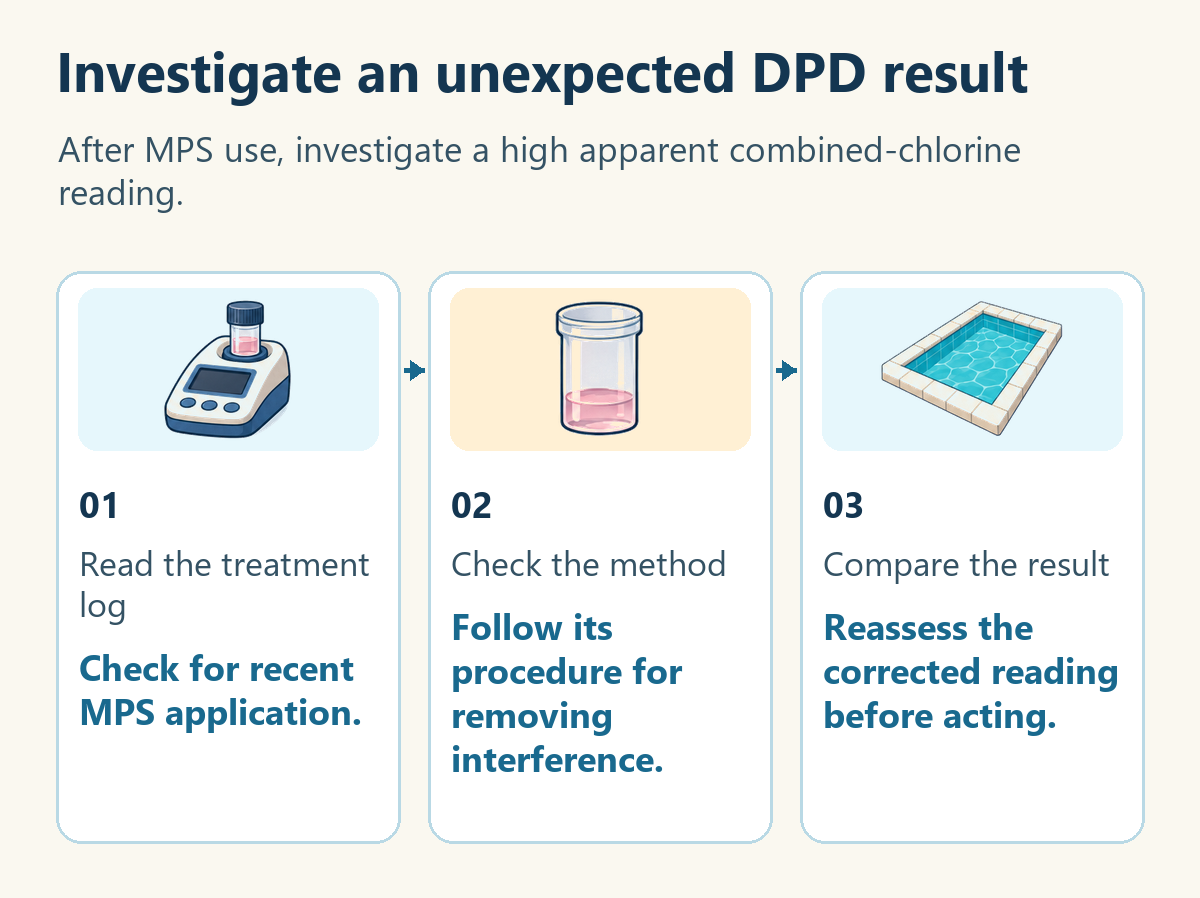
Never launch a 10x breakpoint chlorine shock based on a standard DPD #3 reading taken after dosing MPS. Free chlorine (FC) is the active sanitizing chlorine available in water, and DPD testing (N,N-diethyl-p-phenylenediamine) measures chlorine by color change or titration. Because the 2024 CDC MAHC defines combined chlorine by subtraction (CC = TC − DPD-FC, where DPD-FC includes cyanurate-bound chlorine when CYA is present), any oxidizer that falsely inflates total chlorine (TC) creates an identical phantom jump in calculated combined chlorine.8
Why MPS Fools DPD #3 (and Triggers Free-Chlorine False Positives Above 25 ppm)
Taylor Technologies explains the chemistry behind the false alarm: residual potassium monopersulfate does not react normally with DPD #1 and #2 free-chlorine reagents at typical maintenance levels, but it readily oxidizes DPD #3 reagent (potassium iodide) used to measure total chlorine, turning the sample dark red and mimicking a massive chloramine spike. PHTA likewise warns that even trace amounts of potassium monopersulfate interfere with FAS-DPD testing, making an interference-removing reagent necessary whenever MPS is in the water.15
Do not assume free chlorine readings are always immune, either. The 2024 CDC MAHC Annex notes two additional boundaries: while any MPS biases combined chlorine high, high MPS concentrations over 25 ppm also produce false-positive free chlorine readings, and cold water samples below 60°F (16°C) should be gently warmed to at least 60°F before testing for accurate results.10
Step-by-Step Verification with Taylor R-0867 Deox Reagent (FAS-DPD & Color Comparator)
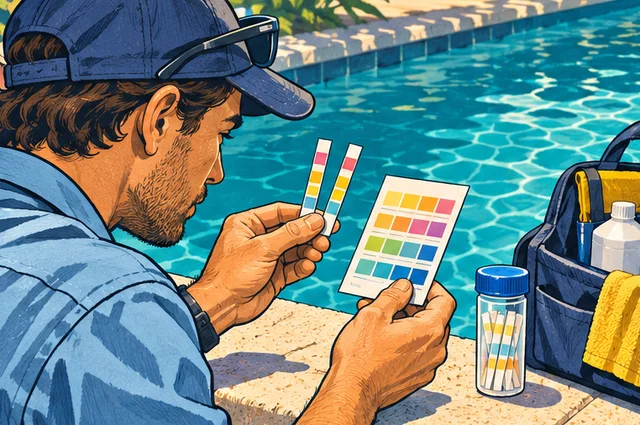
An MPS interference remover (deox reagent) chemically neutralizes residual potassium monopersulfate in the test vial before DPD #3 is added, letting you read true free and combined chlorine. Taylor Technologies supplies R-0867 Deox Reagent in two add-on packs for existing DPD or FAS-DPD kits—K-2041 (0.75 oz) and K-2042 (2 oz)—as well as the standalone K-1518 FAS-DPD chlorine/monopersulfate kit.
Follow Taylor Instruction #5807 (June 2024) in exact order—timing matters because R-0867 must neutralize MPS promptly before adding R-0003:
Post-MPS DPD Verification Checklist (Taylor R-0867 / K-2042):
- Check sample temperature first: If pool water is below 60°F (16°C), gently warm the sample tube to at least 60°F before adding reagents.10
- FAS-DPD titration workflow (25 mL sample): Fill the vial to 25 mL, add 1 heaping dipper of R-0870 DPD Powder, quickly swirl to mix, then promptly add 1.0 mL of R-0867 Deox Reagent and quickly swirl to mix; titrate dropwise with R-0871 until the sample turns from pink to colorless (multiply drops by 0.2 ppm) to record true free chlorine (FC). Next, add 10 drops of R-0003, swirl to mix, wait 1 full minute, and titrate again with R-0871 from pink to colorless (drops × 0.2 ppm) to record true combined chlorine (CC).
- DPD color comparator workflow (9 mL sample, 0.5–5 ppm range): Fill the comparator tube to 9 mL, add 5 drops of R-0001 and 5 drops of R-0002, cap and invert to mix, then promptly add 0.5 mL of R-0867 Deox Reagent, cap and invert to mix, and match color to record true FC. Immediately add 5 drops of R-0003, cap and invert to mix, wait 1 full minute, and match color to record true total chlorine (TC), then subtract FC from TC for true CC.
- Act only on verified true CC: If deox-verified combined chlorine still exceeds 0.4 ppm (or your local state limit), close the pool and move to our Breakpoint Chlorination Calculation protocol.
Calculating Residual MPS (MC = TO − [FC + CC]) and What to Do Without Deox Reagent
Taylor Instruction #5807 also lets you quantify how much monopersulfate compound (MC, expressed as Cl₂) remains in the water by running a parallel standard test without R-0867 to measure Total Oxidizer (TO), then subtracting true chlorine:
- FAS-DPD formula:
MC = TO − (FC + CC) - Color comparator formula:
MC = TO − TC
Field Testing Notes — High MPS (>25 ppm), Cold Samples (<60°F), and Small Negative MC Values: Warm samples under 60°F (16°C) before testing and keep in mind that MPS above 25 ppm skews free chlorine as well as combined chlorine.10 When subtracting
TO − (FC + CC), Taylor Instruction #5807 notes that a negative value for MC may be obtained when residual MC is zero (0) or very low (0–0.4 ppm as Cl₂) due to normal drop-size and sample variation—do not misread a small negative value as a high residual or confirmed absolute zero.
If a route truck runs out of R-0867 Deox Reagent, check for active MPS using dedicated monopersulfate test strips or wait until residual MPS fully dissipates before trusting standard DPD #3 combined-chlorine numbers. Never dump 10x breakpoint chlorine into a clear, odor-free pool solely because an unneutralized DPD #3 test flashed dark red right after an MPS shock.
Once your test readings are reliable, the remaining operational question is what repeated MPS dosing leaves behind in your pool water chemistry and chemical room.
Water Balance Side Effects: pH Drop, Alkalinity Consumption, Sulfates, and Safe Handling
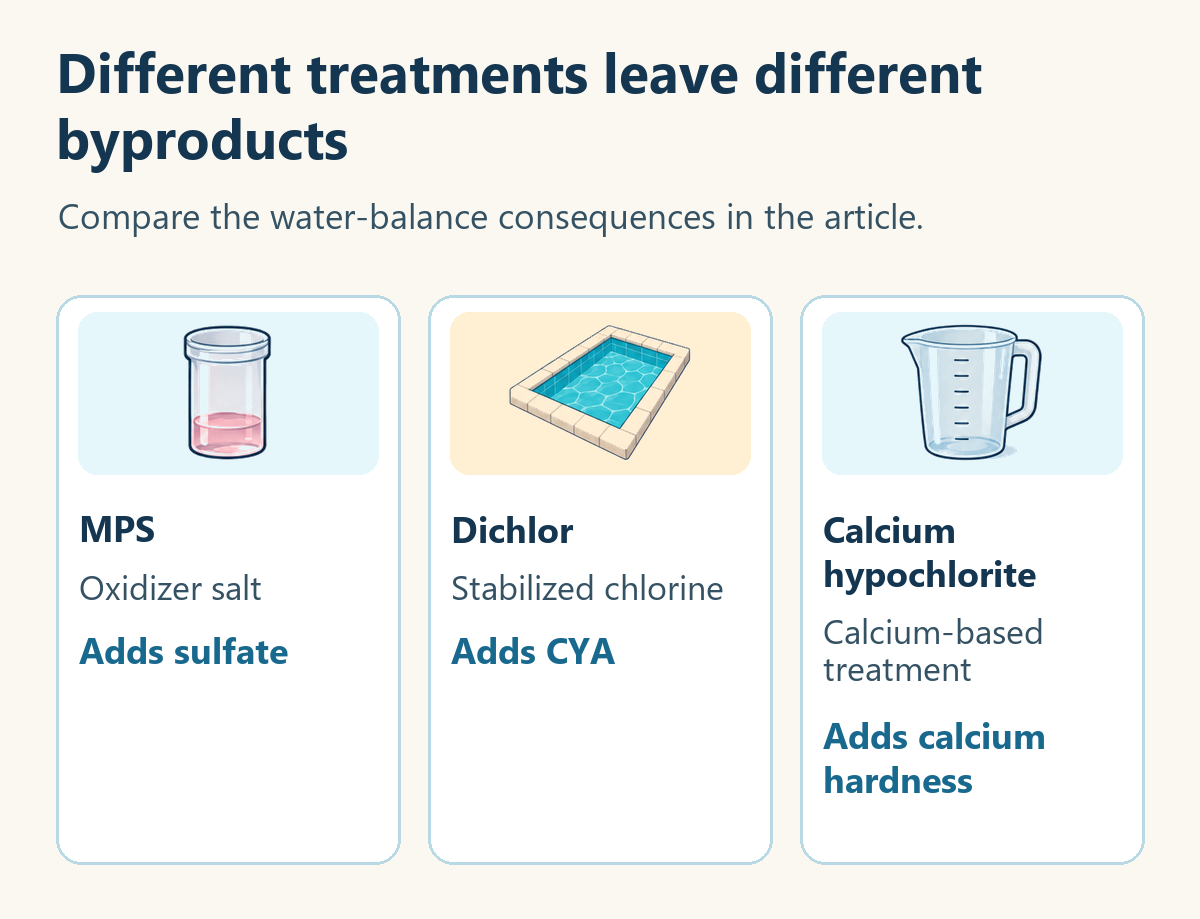
MPS trades cyanuric acid and calcium hardness buildup for acidity and sulfate accumulation. LANXESS Oxone product data confirms that potassium monopersulfate adds zero cyanuric acid (unlike dichlor or trichlor), adds zero calcium hardness (unlike calcium hypochlorite), and dissolves cleanly without clouding pool water. That clean dissolution makes MPS attractive on high-CYA or high-calcium accounts, yet repeated dosing still shifts water balance downward and adds dissolved solids that require monitoring.
Acidity, Alkalinity Drop, and Buffered vs. Unbuffered MPS Formulations
Commercial Oxone-based MPS is a triple salt (2KHSO5·KHSO4·K2SO4, molecular weight 614.7 g/mol); per HASA Oxidizer SDS No. 214 (August 2026), HASA's specific listed formulation contains 43.0% potassium peroxymonosulfate, 23.0% potassium bisulfate, 29.0% potassium sulfate, 3.0% potassium peroxydisulfate, and 2.0% magnesium carbonate. Because potassium bisulfate and peroxymonosulfate are strongly acidic, HASA's 2026 SDS reports that a 1% aqueous solution of unblended Oxone has a pH of 2.3—and solutions above 3% by weight drop below pH 2.0.
In pool water, that acidity drives pH and alkalinity drop by neutralizing carbonate and bicarbonate buffer, shifting the Langelier Saturation Index (LSI) toward corrosive water if left uncorrected. However, not every bucket behaves the same: retail spa-oriented MPS blends such as Leisure Time Renew are formulated with pH buffers specifically to minimize pH drift.
Check the product label and SDS to confirm whether your facility buys unblended commercial Oxone or a pH-buffered spa blend, then test pH and total alkalinity after heavy oxidation and rebalance with our Langelier Saturation Index for Pools guide. If pool water turns milky after any shock treatment—whether from calcium precipitation or filtration lag—diagnose it with our Why Pool Water Turns Milky or Cloudy After Shocking troubleshooting guide.
Sulfate and TDS Accumulation vs. Zero CYA / Zero Calcium Trade-Off
Every pound of MPS triple salt dissociates into potassium and sulfate ions that stay dissolved until physical dilution via splash-out, backwashing, or partial draining removes them. Over months of routine indoor oxidation, sulfate buildup pushes total dissolved solids (TDS) upward and raises surface-deterioration risk: UK PWTAG guidance flags that sulfate concentrations above 360 mg/L pose a corrosion hazard to cementitious grout and cement, and advises holding TDS within 1,000 mg/L above incoming make-up water (with an explicit exception for electrolytic chlorine/saltwater pools).18
On saltwater pools, MPS avoids running the electrolytic cell in high-output shock mode, yet high sulfates can also concern chlorinator manufacturers. Because published sulfate guidance for salt-chlorinator cells varies by equipment maker, consult your specific salt-chlorinator manual and pair regular MPS use with scheduled fresh-water dilution rather than treating MPS as a zero-byproduct chemical.
Storage Stability and Chemical Mixing Hazards (MAHC & 2026 SDS)
Chemical-room discipline around MPS is just as strict as around calcium hypochlorite or liquid chlorine. The 2024 CDC MAHC Annex reports that improper chemical mixing was a factor in 39.8% of 221 documented pool chemical incidents with secondary factors, and explicitly prohibits mixing oxidizers—including monopersulfate, calcium hypochlorite, and bleach—with other chemicals or adding water directly to concentrated chemical.6
Critical Safety Hazard — Never Mix MPS with Chlorinated Shocks or Metal Salts: HASA Oxidizer SDS No. 214 (Section 10.4, August 2026) warns that mixing Oxone MPS with active halogen compounds such as sodium dichloroisocyanurate or calcium hypochlorite in the presence of moisture can release toxic chlorine gas, while contact with heavy-metal salts (cobalt, nickel, copper, or manganese) triggers exothermic oxygen release. Keep dedicated, clearly labeled scoops for each chemical, store MPS cool and dry away from chlorinated products, and always add chemical to water—never water to chemical.6
With chemical efficacy, DPD testing, and surface risks mapped out, the final operational question is the budget: how much more does MPS cost per treatment, and when does facility uptime pay for the premium?
Per-Treatment Cost vs. Pool Downtime: When Paying More for MPS Makes Sense
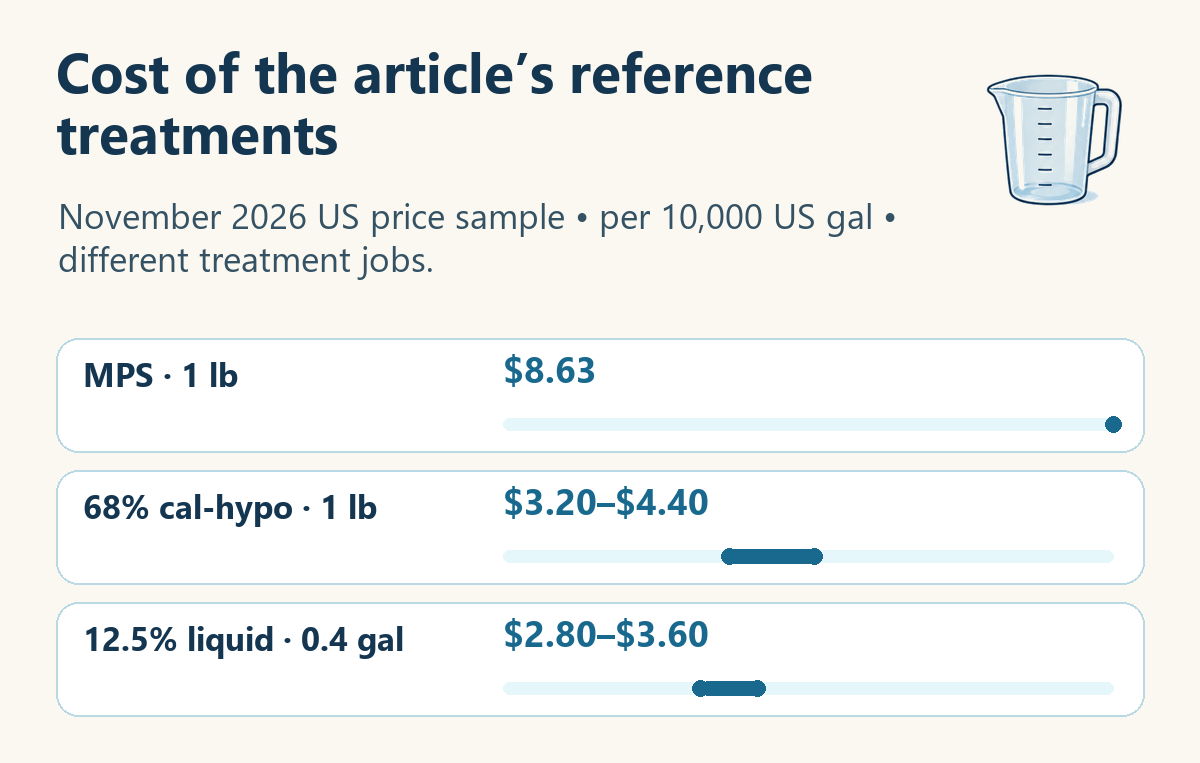
Per pound of oxidizer, MPS almost always costs more than bulk liquid chlorine or calcium hypochlorite—so the decision comes down to whether avoiding pool closure is worth a few extra dollars per treatment. Public US retail and commercial-pail listings viewed as of 2026-11 put bulk 68% calcium hypochlorite and 12.5% liquid chlorine well below small-pack Oxone MPS per 10,000 US gallons (37.85 m³).
Direct Chemical Cost per 10,000 US Gallons and per 10 m³ (Data as of 2026-11)
The comparison below uses public US product listings viewed in November 2026 paired with LANXESS weekly MPS dosing and PHTA RWQC / Appendix B-2 chlorine shock benchmarks. Commercial contract and distributor bulk pricing varies by region, pack size, and season.
| Shock Product & Reference Pack (2026-11) | Observed Public Unit Price | Reference Dose per 10,000 US gal (per 10 m³) | Est. Direct Cost per 10,000 US gal | Est. Direct Cost per 10 m³ |
|---|---|---|---|---|
| Oxone MPS (Leisure Time Renew, 2.2 lb bottle) | $18.99 ($8.63/lb) | 1 lb (120 g) weekly oxidation | ~$8.63 | ~$2.28 |
| 68% Cal-Hypo granular (Pool Country, 50 lb pail) | $159.99 sale–$219.99 reg ($3.20–$4.40/lb) | 1 lb (~8.2 ppm FC; 120 g) or 1.25 lb (+10 ppm; 158 g, PHTA B-2 40,000 L col.)13 | $3.20–$4.40 (1 lb); $4.00–$5.50 (1.25 lb)13 | $0.85–$1.16 (1 lb); $1.06–$1.45 (1.25 lb)13 |
| 68% Cal-Hypo commercial (Aquafit AS3, 50 lb pail) | $294.95 ($5.90/lb) | 1 lb (120 g) or 1.25 lb (+10 ppm; 158 g, PHTA B-2 40,000 L col.)13 | ~$5.90 (1 lb); ~$7.37 (1.25 lb)13 | ~$1.56 (1 lb); ~$1.95 (1.25 lb)13 |
| 12.5% Liquid chlorine (Leisure Pool & Spa, 1 gal / 4-gal case) | $7.00/gal ($27.99/4 gal) to $8.99/gal | 0.4 gal (+5 ppm; 0.40 L) or 0.8 gal (+10 ppm; 0.80 L) | $2.80–$3.60 (+5 ppm); $5.60–$7.19 (+10 ppm) | $0.74–$0.95 (+5 ppm); $1.48–$1.90 (+10 ppm) |
Three billing details keep these comparisons apples-to-apples:
- Pack-size spread: The MPS benchmark above reflects a 2.2 lb small retail bottle ($8.63/lb, Data as of 2026-11). Larger commercial MPS pails typically reduce per-pound cost compared with small bottles, so compare delivered distributor quotes against bulk sodium hypochlorite or calcium hypochlorite before standardizing a weekly shock budget.
- PHTA Appendix B-2 shock volumes: For a full +10 ppm free chlorine shock, PHTA Appendix B-2 (2021) lists 1.25 lbs of 67% cal-hypo per 10,000 US gallons (630 g per 40,000 L, or 158 g per 10 m³ in the separate metric column, versus ~150 g scaled directly from 1.25 lb) and 3.3 US quarts (105.6 fl oz / 0.825 gal) of 12% liquid chlorine per 10,000 gallons (3.3 L per 40,000 L, or 0.83 L per 10 m³).13 Scale those baselines to your exact basin volume with our Pool Chemical Dosage Chart.
- Chlorine format choice: When your facility chooses chlorine shock over MPS, compare liquid sodium hypochlorite versus granular calcium hypochlorite handling, storage decay, and side effects in our Pool Shock Liquid vs Powder guide.
Budget Caveat (Data as of 2026-11): Direct chemical costs above reflect public US online listings observed in November 2026 and do not include freight, hazmat delivery fees, or commercial distributor volume discounts. Compare delivered per-pound quotes against your facility's actual closure cost per hour before standardizing your weekly shock schedule.
When Uptime and Salt-Cell Longevity Justify MPS—and When Overnight Chlorine Wins
LANXESS notes that the core economic argument for MPS in public and commercial pools is avoiding multi-hour closures while free chlorine shock dissipates back below 4 ppm or applicable local code maximums, alongside reducing electrolytic cell wear on saltwater chlorine generators compared with repeatedly running "shock mode"—and under 2024 MAHC Annex guidance, EPA labels cap bather re-entry at 4 ppm in pools and 5 ppm in spas.
- Choose MPS on high-utilization uptime accounts: Indoor swim schools, hotel pools, health-club lap pools, therapy spas, and heavy-load saltwater facilities can quickly offset a few dollars of extra oxidizer cost whenever keeping a swim block open prevents refunds, complaints, or rescheduling.
- Choose unstabilized chlorine shock on overnight-closure routes: Outdoor commercial pools, residential service routes, and facilities that already close every evening rarely benefit from a 15-minute re-entry window—shocking overnight with 12.5% liquid chlorine or bulk 68% cal-hypo lowers direct chemical spend while providing sanitizer oxidation and algae control.
Before locking in your shock schedule, run through four quick field questions route technicians and spa operators ask most often about timing, pump runtime, and compatibility.
Common Field Questions on Using Non-Chlorine Shock
Can you use non-chlorine shock and chlorine on the same day?
Yes, provided they are never mixed together dry, in a bucket, or in a feeder. HASA Oxidizer SDS No. 214 warns that mixing MPS with active halogen compounds such as dichlor or calcium hypochlorite in the presence of moisture can release toxic chlorine gas. Once one chemical has fully dissolved and circulated through the pool water, MPS coexists normally with an active free chlorine residual—though dosing heavy chlorine shock on the same day cancels MPS's 15-minute re-entry advantage (which otherwise requires existing FC and pH within local code and following the container label) because bathers must still wait for free chlorine to drop within label and code caps.
Should you run the pump and dose MPS during the day or at night?
Run the circulation pump during and after dosing while the pool is unoccupied, and confirm existing sanitizer and pH already meet local code before reopening. LANXESS Oxone guidance specifies applying 1 lb per 10,000 US gallons to an unoccupied pool and circulating for 15 minutes before re-entry, while Haviland Clear Result directs applying unoccupied with the pump running and notes quick access within 15 minutes—always verify the exact directions on your specific container label. Because MPS does not raise free chlorine above bather caps, daytime between-session oxidation is practical on commercial schedules.
Is non-chlorine shock good for saltwater pools?
Yes, for routine preventive oxidation when free chlorine is already on target. LANXESS specifically recommends weekly MPS dosing at 1 lb per 10,000 US gallons as an alternative to running saltwater chlorine generators in high-output "shock mode," helping limit electrolytic cell wear. Pair weekly MPS on salt pools with regular fresh-water dilution and verify your salt-cell manufacturer's sulfate tolerance in the equipment manual.
Can you use MPS non-chlorine shock in hot tubs and bromine spas?
Yes—and in bromine spas it pulls double duty. Product guidance for Oxone-based spa shocks (such as Leisure Time Renew) confirms that MPS oxidizes organic bather waste while converting dissolved bromide ions back into active sanitizing hypobromous acid (HOBr). Apply with the spa unoccupied, circulation running, and existing sanitizer and pH within local code, and follow the exact dose per gallon or litre and cover-ventilation directions printed on your specific spa product label.
Match MPS to Preventive Oxidation—Reserve Chlorine for Sanitation and Verified Chloramines
Treat potassium monopersulfate (MPS) as a targeted preventive oxidizer, not an all-purpose replacement for chlorine shock. It earns its keep on high-bather-load indoor, hotel, bromine, and saltwater pools when free chlorine and pH are already on target, water is clear, and avoiding hours-long closure pays for the higher unit chemical cost. Keep unstabilized chlorine shock as your mandatory response for active algae, low free chlorine, fecal or Cryptosporidium incidents, and verified inorganic chloramines.
Standardize three deck habits whenever MPS enters a facility program: keep a deox reagent (such as Taylor R-0867 / K-2042) in every test kit so residual MPS does not mislead you into a false 10x breakpoint chlorination; store and scoop dry oxidizers completely separate from chlorinated shocks; and balance MPS's zero-CYA, zero-calcium benefit against ongoing pH/alkalinity checks and fresh-water dilution for sulfates.
Use the related guides across our Water Chemistry hub for the next operational step on your deck:
- Scale exact chemical amounts in US gallons or cubic metres with our Pool Chemical Dosage Chart.
- Calculate exact 10x chlorine doses once deox testing confirms true combined chlorine with Breakpoint Chlorination Calculation.
- Fix recurring indoor combined chlorine at the ventilation, UV, and turnover level in Why Combined Chlorine Keeps Coming Back in Indoor Pools.
- Compare liquid sodium hypochlorite against granular calcium hypochlorite and dichlor in Pool Shock Liquid vs Powder.
- Troubleshoot milky post-shock water in Why Pool Water Turns Milky or Cloudy After Shocking.
- Regional health-code corrections and technical errata are logged via the PoolTradeDesk contact page.
References
- CDC Healthy Swimming — Combined Chlorine Calculation & Superchlorination Steps — 2024
- CDC Healthy Swimming — Fecal Incident Response Recommendations for Aquatic Staff (June 2018) — 2018-06-22
- HSE HSG282 — Control of Legionella & Other Infectious Agents in Spa-Pool Systems (Microbial Actions) — 2017
- Lake County Health Department — Breakpoint Chlorination (10x Rule) & Non-Chlorine Oxidizer Limits
- CDC 2024 MAHC Annex (5th Ed.) — Combined Chlorine 0.4 ppm Action Threshold & Chloramine Odor Limits — 2024-12-16
- CDC 2024 MAHC Annex (5th Ed.) — Chemical Label Compliance, Pre-Dissolution & Segregation — 2024-12-16
- CDC 2024 MAHC (5th Ed.) — Imminent Health Hazards & Maximum Disinfectant Limits (6.6.3.1) — 2024-12-16
- CDC 2024 MAHC (5th Ed.) — Glossary Definitions of Free, Combined & DPD-FC Chlorine — 2024-12-16
- CDC 2024 MAHC Annex (5th Ed.) — Recommended Free Chlorine Ranges & 10 ppm Bather Ceiling — 2024-12-16
- CDC 2024 MAHC Annex (5th Ed.) — Potassium Monopersulfate Interference on Combined & Free Chlorine Tests — 2024-12-16
- CDC 2024 MAHC Annex (5th Ed.) — Non-Chlorine Shock Oxidizers & Inorganic Chloramines — 2024-12-16
- Minnesota Department of Health — Chloramines in Pool Make-Up Water (January 2023) — 2023-01
- Pool & Hot Tub Alliance (PHTA) — Pool & Spa Operator Handbook Appendix B (2021) — 2021
- Pool & Hot Tub Alliance (PHTA) RWQC — Fact Sheet: Sodium Hypochlorite (March 2020) — 2020-03
- PHTA Pool & Spa Operator Handbook — Potassium Monopersulfate Interference in FAS-DPD Testing — 2021
- PHTA Pool & Spa Operator Handbook — Non-Chlorine Oxidizers Glossary Definition — 2021
- PHTA — Chemicals & Processes Incompatible with PHMB Sanitizers — 2021
- PWTAG — Swimming Pool Alkalinity, Calcium Hardness, TDS & Sulfate Control Limits — 2024
- PWTAG Technical Note 23 — Superchlorination Concentrations, Contact Times & Dechlorination — 2024
How this guide was prepared
Prepared by Martin. Based on 19 cited sources listed in References. Content date: 2026-11-27.