Run a hybrid shelf instead of going all-in on private label or national brands. Keep recognized national brands to pull walk-in traffic and cover federally regulated sanitizers, and launch private label first in non-pesticide repeat consumables such as test strips, reagent tablets, filter cartridges, clarifiers, and residential pool salt.
PoolTradeDesk, operated by our company, Kingnod (established in 2009), built this trade guide from US federal and state statutes, retail scanner data, and factory order structures. Below, we compare true net economics, federal versus non-pesticide rules, a three-phase launch order, legal and shelf-life limits, and a pre-deposit supplier checklist.
- Where the margin comes from: Many of the largest consumer packaged goods (CPG) makers spend 20 cents or more per dollar on trade promotion and advertising, and academic scanner research from one large Midwestern supermarket chain finds lower-bound brand markup ratios of 1.40-2.10 across most categories studied.1613
- The hidden offset: Switching away from major brands forfeits manufacturer-funded displays, rebates, dealer days, and national advertising pull.
- Entry minimums vary sharply: In one Pool & Spa News supplier example, Canadian manufacturer Capo Industries cited at least 1,000 units per year for its own private-label chemical runs, while factory-direct non-pesticide orders step up from small test-strip runs to 1-pallet specialty lines and 1-container bulk pH balancers.
- Cash timing shifts forward: Direct factory imports use wire-transfer deposit terms or a letter of credit at sight instead of local distributor trade credit.
Private Label vs. Branded Pool Chemicals: Margins, MOQs, and Working Capital Compared
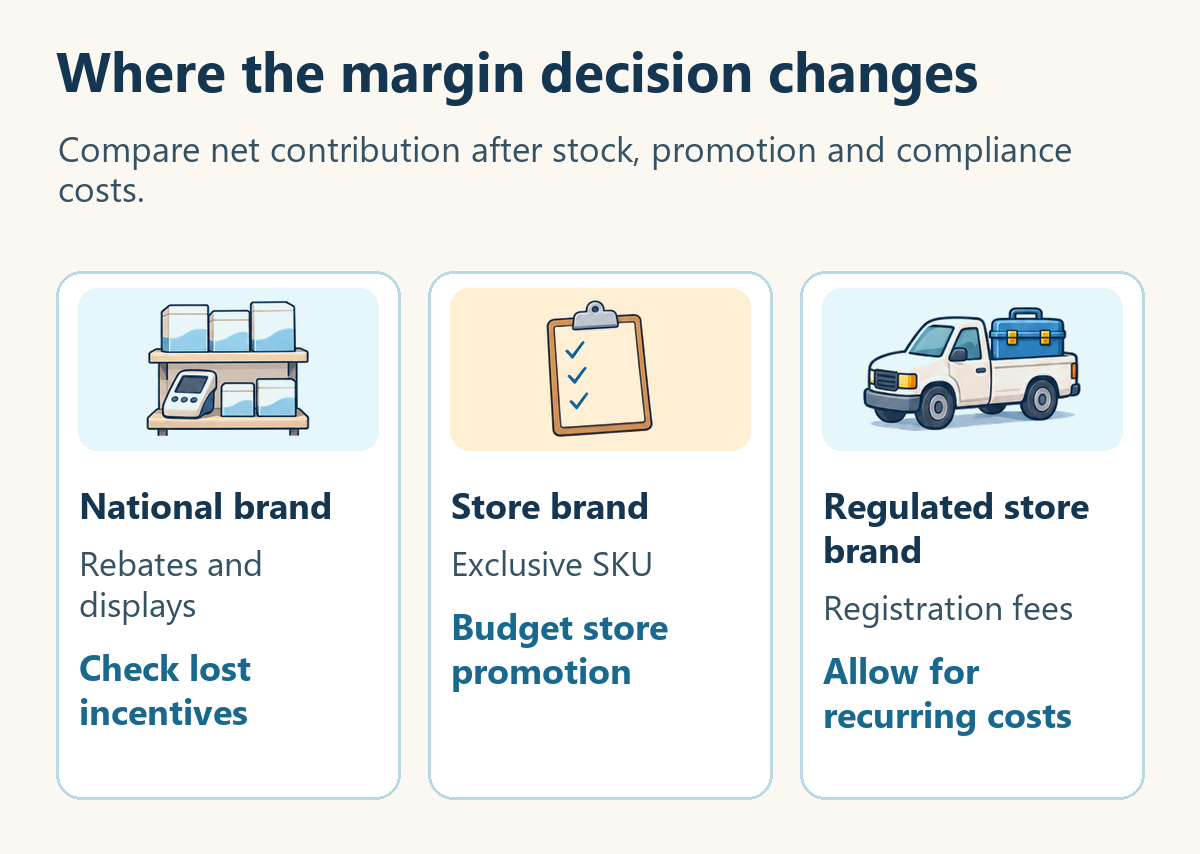
Private-label pool chemicals give stores room to widen unit margin without funding national-brand advertising and shield your shelf from direct barcode price matching. Still, real net profit only shows up after you subtract lost brand rebates and verify that annual store sales clear each supplier's minimum order quantity (MOQ — the smallest run a supplier will produce for one SKU).
In this guide, OEM (original equipment manufacturing) means factory production packaged under your store's own label, and a hybrid assortment means keeping national brands beside selective store-brand lines.
Branded vs. Private-Label Trade-Offs Side by Side
Across US supermarkets, drug chains, and mass merchandisers, PLMA (Private Label Manufacturers Association) and Circana Unify+ data (52 weeks ending December 28, 2025) put total store-brand sales at $282.8 billion (+$9 billion year over year) and 68.7 billion units, reaching 21.3% dollar share and 23.5% unit share.16 Store-brand dollars rose 3.3% in 2025, nearly three times the 1.2% gain of national brands, while store-brand units grew 0.6% as national brands fell 0.6%.16
Those figures are cross-retail US benchmarks, separate from a pool-store-only survey. They show why shoppers accept house brands, and why PLMA notes that many of the largest CPG manufacturers spend 20 cents or more per dollar on trade promotion and advertising (a spending benchmark rather than a measured private-label capture rate).16 Similarly, Barsky, Bergen, Dutta, and Levy (NBER Working Paper 8426, 2001) examined scanner data for over 230 nationally branded products across 19 US supermarket categories at one large Midwestern chain and found lower-bound full markup ratios of 1.40-2.10 in most categories.13
In pool retail specifically, dealer territory exclusivity has largely disappeared. N. Jonas VP Ed Wexler observed in Pool & Spa News (December 5, 2016) that stores have no guarantee a national brand will not appear online or down the street. In that same report, Massachusetts retailer Teddy Bear Pools—operating for over 40 years with 37 service trucks—had built store-labeled goods to roughly 95% of inventory while pricing about 10% below major-label retail.
That single regional case illustrates long-term potential for an established operator, not a first-year result for a new shop. Inventory turnover behaves just as differently: case-by-case national-brand restocks turn fast on distributor credit, whereas pallet or container private-label orders often must be planned to clear across one or two swim seasons.
| Decision Factor | National Branded Lines | Private Label (Non-Pesticide Lines) | Private Label (EPA-Regulated Sanitizers) |
|---|---|---|---|
| Margin & Pricing Lever | Lower-bound markup 1.40-2.1013 | No national ad budget; net rebates | Spread offset by state fees |
| Online Barcode Price Protection | Low; easy online matching | High; store-exclusive SKU | High; store-exclusive brand |
| Co-Op Marketing & Rebates | Displays, rebates, ad pull | Store funds local push | Limited display; no ad pull |
| Typical Entry MOQ & Cash Timing | Case orders on credit | Small to 1 container; T/T or sight L/C | Set by US basic registrant + fees |
| Regulatory & Label Overhead | Handled by brand owner | No EPA fee; SDS on balancers | Joint EPA filing + state fees |
| Pool-Store Average Gross Margin % | No reliable public data | No reliable public data | No reliable public data |
Three lines in that table decide whether private label actually makes money for your store:
- Pool-store gross margin percentage has no audited national average. No public nationwide survey tracks exact average gross margins specifically for independent US pool chemical retailers. Plug your current distributor invoice, annual rebate credits, and landed OEM quote into one spreadsheet to calculate your store's own spread.
- Lost brand support cuts into headline savings. Put annual brand rebates, free display racks, and dealer-day promotions on the same spreadsheet line as unit purchase cost before comparing a private-label quote.
- Entry MOQ and cash timing vary sharply by tier. Non-pesticide private label spans small test-strip runs, 1-pallet specialty items, and 1-container bulk balancers—and direct factory imports run on T/T deposit terms or a letter of credit at sight, explained right below.
Margin Gain vs. Co-Op Loss: Many of the largest CPG brands spend 20 cents or more per dollar on advertising and trade promotion, which creates pricing room for private labels.16 Yet PoolCorp retail category manager Ted Lawrence cautioned in Pool & Spa News (2016) that private labeling is not automatically cheaper once a store gives up manufacturer-funded displays, rebates, coupons, dealer days, and digital marketing. Stores with strong local traffic capture the spread; newer shops still reliant on national-brand walk-ins can lose net profit.
MOQ Tiers, Upfront Cash, and Store Break-Even Reality
Working capital separates single-store experiments from multi-store or distributor programs. In Pool & Spa News (December 5, 2016), Mark Ridpath of Canadian manufacturer Capo Industries (Burlington, Ontario) remarked that private-label chemical production makes sense for his company when a buyer purchases at least 1,000 units per year—one supplier's production floor rather than a universal US EPA-sanitizer or per-SKU standard.
Factory-direct OEM programs break entry volume into three distinct tiers. At Kingnod (our company), OEM private-label MOQs match confirmed standard non-OEM minimums for the same product with no separate universal trial tier. Across non-pesticide pool lines, those verified tiers step up as follows:
- Small-to-large flexible orders: Water-test strips with custom branding, labels, and packaging accept small, medium, and large orders, fitting a single store's first test budget.
- 1-pallet tier: Non-pesticide pool clarifier gel cubes start at 1 pallet. Refined granular pool sea salt (25 kg PP woven bags) also starts at 1 pallet; confirm custom-bag printing minimums alongside your packaging specs.
- 1-container tier: Commodity pH balancers—both soda ash (pH Plus, where OEM MOQ matches non-OEM and tonnage varies by pack) and sodium bisulphate (pH Minus)—start at 1 full container each, suited to regional distributors or multi-store chains with steady seasonal pallet turnover.
Cash timing and packaging setup costs complete the break-even math. Local wholesale distributors ship case-by-case on trade credit. Direct factory OEM terms at Kingnod (our company) run T/T (telegraphic wire transfer) 30% in advance and 70% against copy of the bill of lading (or 100% letter of credit at sight) under requested international ocean shipping terms—FOB (buyer arranges ocean freight and insurance), CFR (seller pays ocean freight while buyer handles insurance), or CIF (seller pays ocean freight and basic cargo insurance)—with typical shipment within 3 weeks after order confirmation (not a binding guarantee).
Budget upfront and recurring packaging setup costs before placing a purchase order. Direct factory orders typically require artwork files, moisture-resistant chemical label stock, and printing plates or cylinders for custom printed bags and buckets (whereas domestic private-label blenders often bundle label design into higher unit wholesale pricing). To test store break-even, add your annual fixed setup costs—artwork and plates, any state brand fees, and foregone brand rebates—and divide that total by your extra gross profit per unit. If the resulting break-even unit count—or the supplier's MOQ—exceeds what your store can sell in one to two swim seasons, hold off on that SKU.
If you are opening a new shop and still building your first-season shelf budget, map your opening inventory mix first in our pool supply store startup guide. Multi-store buyers planning container arrival dates should pair these MOQ tiers with our pool chemical lead-time calendar.
Even when the unit economics look attractive on paper, federal and state pesticide law creates a sharp cost and timeline divide between sanitizers and non-pesticide lines—so check the regulatory split before picking your first SKU.
EPA FIFRA vs. Non-Pesticide Pool Chemicals: The Regulatory Split That Drives Launch Cost
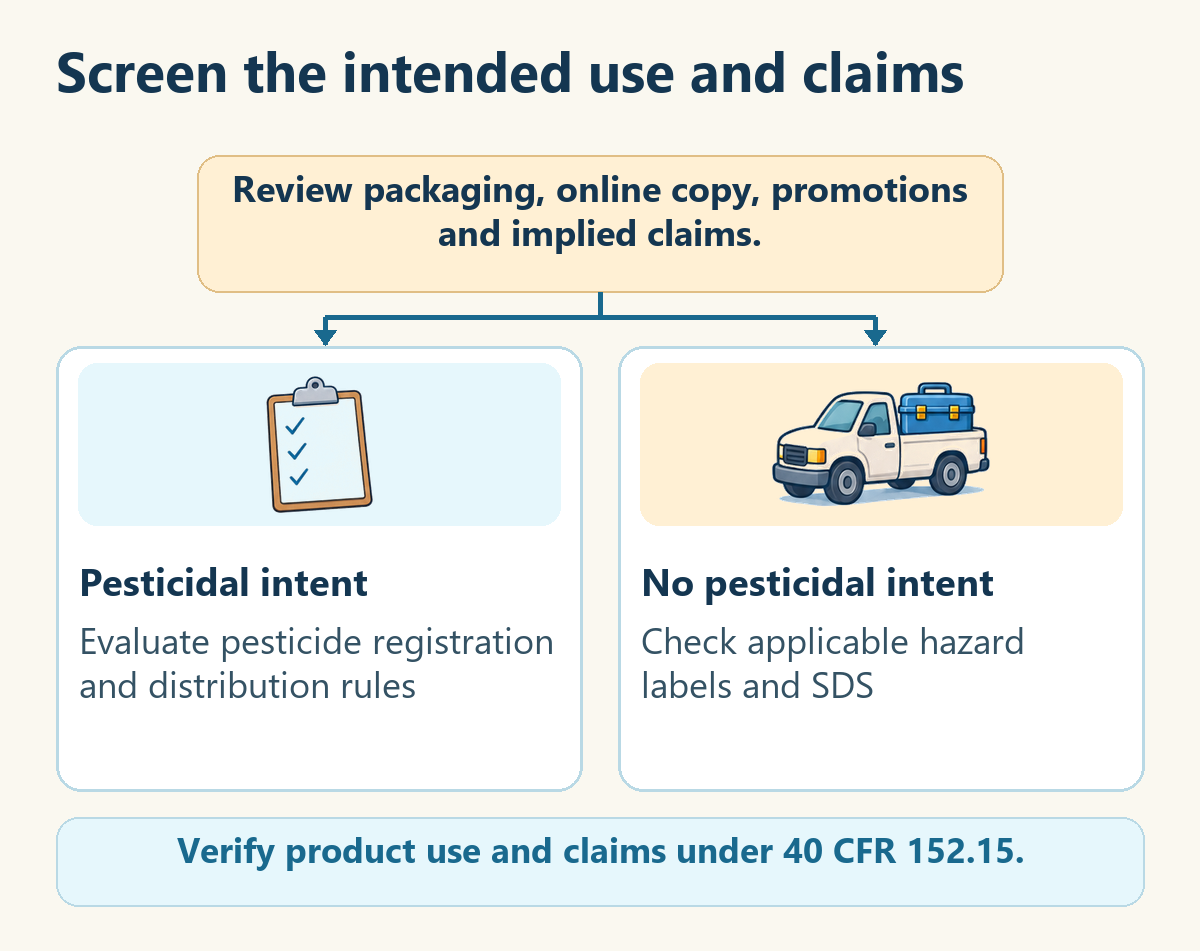
US federal pesticide law splits pool chemicals into two completely different private-label tracks. Sanitizers, algaecides, and any product carrying pest-control claims trigger federal supplemental registration plus initial and recurring state brand fees, whereas non-pesticide lines skip EPA registration and follow workplace hazard labeling rules instead.
Under FIFRA (Federal Insecticide, Fungicide, and Rodenticide Act) section 2(u) and 40 CFR 152.15, a pool product is legally regulated as a pesticide whenever the seller claims, states, or implies on the label or elsewhere that it prevents, destroys, repels, or mitigates pests such as bacteria or algae.5
EPA FIFRA Supplemental Distribution and State Registration Fees (Sanitizers & Algaecides)
To sell a federally registered chlorine, bromine, or algaecide product under your store name in the United States, you use supplemental distribution—EPA's legal program under 40 CFR 152.132 that lets a distributor sell an already registered pesticide under its own brand name.4 Four strict statutory conditions apply:
- Joint signature, distributor company number first, and registrant filing. Under 40 CFR 152.132(a) and EPA's Pesticide Registration Manual Chapter 9 (updated September 11, 2026), the distributor must obtain an EPA-assigned company number before EPA Form 8570-5 is completed, both the basic registrant and the distributor must sign Form 8570-5, and only the basic registrant—never the private-label retailer alone—can submit the signed form through MyPest.46
- No repackaging and no unregistered labeling. Under 40 CFR 152.132, the product must be produced, packaged, and labeled inside the basic producer's registered facility (or a registered contract establishment) and never repackaged by the distributor.4 EPA labeling Q&A LC07-0120 and LC06-27 (updated April 13, 2026) confirm that applying a pesticide label to an imported commodity chemical at a public warehouse counts as pesticide production, requiring that warehouse to hold an EPA Est. No. (EPA Establishment Number — the code identifying the exact facility that packaged or labeled the product) printed on the container.9
- Mandatory registration numbering and zero added claims. Every supplemental jug must print the basic registrant's EPA Reg. No. (EPA Registration Number — the federal product approval ID) followed by a dash and your company number.4 Per EPA Label Review Manual Chapter 3, your store label may delete approved claims from the master label, yet it cannot add new claims, use sites, or pests.7
- Linked websites become regulated labeling. Printing your store URL or QR code on a pesticide container makes that webpage regulated labeling subject to EPA review, so online copy cannot go beyond registered label claims.8
Federal clearance is only the first gate. State pesticide registration—per-state brand approval layered on top of federal EPA registration—adds direct fixed costs to every private-label sanitizer SKU:
| Compliance Track | Governing Rule | Direct Filing / Fee Benchmark | Operational Restriction |
|---|---|---|---|
| US Federal Sanitizers / Algaecides | 40 CFR 152.132 / Form 8570-546 | Both sign; registrant files MyPest | Zero repackaging; zero added claims7 |
| California State Brand Fee | 3 CCR § 6148 & § 621512 | $1,500 initial filing / brand1 | 60-day renewal review; perjury filing2 |
| Florida State Brand Fee | 2026 F.S. § 487.04111 | $700 biennial ($350 even-year)11 | Jan 31 due; FDACS exit notice + 2-year hold11 |
| US Non-Pesticide Hazardous Balancers | OSHA HCS 29 CFR 1910.120015 | No EPA or state pesticide fee | GHS hazard labels + 16-section SDS15 |
| Commercial Public Pools (MAHC) | MAHC via NSF summary14 | Certification or federal reg. | NSF 50 or 60, or FIFRA (biocides need FIFRA)14 |
| GB / NI / EU Biocide Distribution | GB BPR / EU ECHA Art. 9512 | Listed active-substance source | GB English chain; NI/EU ECHA12 |
California and Florida show how fast initial and recurring state fees compound across a multi-SKU sanitizer line. Under California DPR 3 CCR § 6148 (operative October 1, 2024), the state charges an initial registration submission fee of $1,500 per product—explicitly covering each additional brand name of a pesticide product (with a 180-day window to fix incomplete applications without paying again).1 Separately, under 3 CCR § 6215, California renewals require an authorized official's adverse-effect disclosure statement signed under penalty of perjury, with renewal issued within 60 days of a complete filing unless statutory enforcement exceptions apply, and separate DPR approval required for label amendments under § 6170(b).2
In Florida, 2026 Florida Statutes § 487.041 charges $700 per brand for a biennial cycle starting in an odd-numbered year ($350 if starting in an even-numbered year) and adds a $25 per month late fee up to $250 per brand when the renewal application is not filed by January 31 of the renewal year; to leave discontinued stock on Florida retail shelves without further registration, FDACS must receive written notification of discontinuation, registration must be maintained for at least 2 years, and the registrant must not distribute that brand in Florida during or after that 2-year period.11 Because state pesticide fee schedules vary across all 50 states and update periodically, verify current fees directly with each state agriculture department before printing multi-state sanitizer labels.
Non-Pesticide Compliance: OSHA GHS, Label Claim Red Lines, Commercial MAHC, and GB/EU BPR
Non-pesticide pool products—water-test strips, reagent test tablets, replacement filter cartridges, pH balancers, water clarifiers without algae claims, and residential pool salt—skip federal and state pesticide fees completely. That makes them far faster to launch, yet three compliance rules still govern what you print and where you sell.
First, hazardous non-pesticide chemicals such as corrosive pH reducers or alkaline pH increasers fall under OSHA's Hazard Communication Standard (29 CFR 1910.1200). OSHA requires manufacturers and importers to classify hazards and supply GHS-aligned labels (signal word, pictogram, hazard statement, and precautionary statements) plus an SDS (Safety Data Sheet — the standardized 16-section chemical hazard document).15
EPA Label vs. OSHA SDS Signal Words: Under EPA Label Review Manual Chapter 3 and PR Notice 2012-1, EPA pesticide labels follow FIFRA toxicity rules rather than OSHA GHS signal words.8 That means a registered sanitizer's 16-section OSHA SDS can legally display a different signal word than its EPA container label—and you cannot move mandatory EPA label warnings onto an SDS to save space.158
Second, watch every word on non-pesticide packaging and product pages. Under 40 CFR 152.15, a single pest-control phrase on a bottle or listing establishes pesticidal intent—triggering FIFRA pesticide classification and making the product an unregistered pesticide if sold without federal registration.5 For instance, cationic flocculant clarifier gel cubes stay outside EPA registration in the United States only when phrases like "helps control algae" are completely omitted from packaging and web copy. Before approving artwork, scan every draft label and linked webpage for words like algae, kill, sanitize, or disinfect and remove them unless backed by federal registration.
Third, check whether your buyers operate commercial public pools or sell outside the United States. In US jurisdictions adopting the Model Aquatic Health Code (MAHC), NSF summarizes (December 20, 2021) that commercial pool chemicals—explicitly including electrolytic chlorinator salts, pH adjusters, and clarifiers—must carry NSF/ANSI/CAN 50 (the third-party recreational-water health standard) or NSF/ANSI/CAN 60 certification, or EPA FIFRA registration.14 However, NSF/ANSI/CAN 50 or 60 certification never replaces federal EPA FIFRA registration for disinfectants, algaecides, or other biocides, and residential-only private-label salt or balancers cannot enter commercial MAHC bids without one of those credentials.
If you distribute biocidal sanitizers in Great Britain rather than the United States, UK HSE enforces BPR Article 95 (the GB Biocidal Products Regulation active-substance supplier list rule): every stage from manufacturer to distributor to retailer must maintain an auditable English-language purchase trail from a GB Article 95 listed supplier, while Northern Ireland and the EU follow ECHA Article 95.12 For broader store compliance guides, visit our Pool Business hub, or move to our private-label launch guide when you are ready for step-by-step filing execution.
Because federal supplemental registration and state brand fees hit sanitizers hardest while non-pesticide consumables face none of those fees, sequence your private-label rollout by regulatory friction first.
Which Pool Chemicals to Private-Label First (and How to Build Shopper Trust)
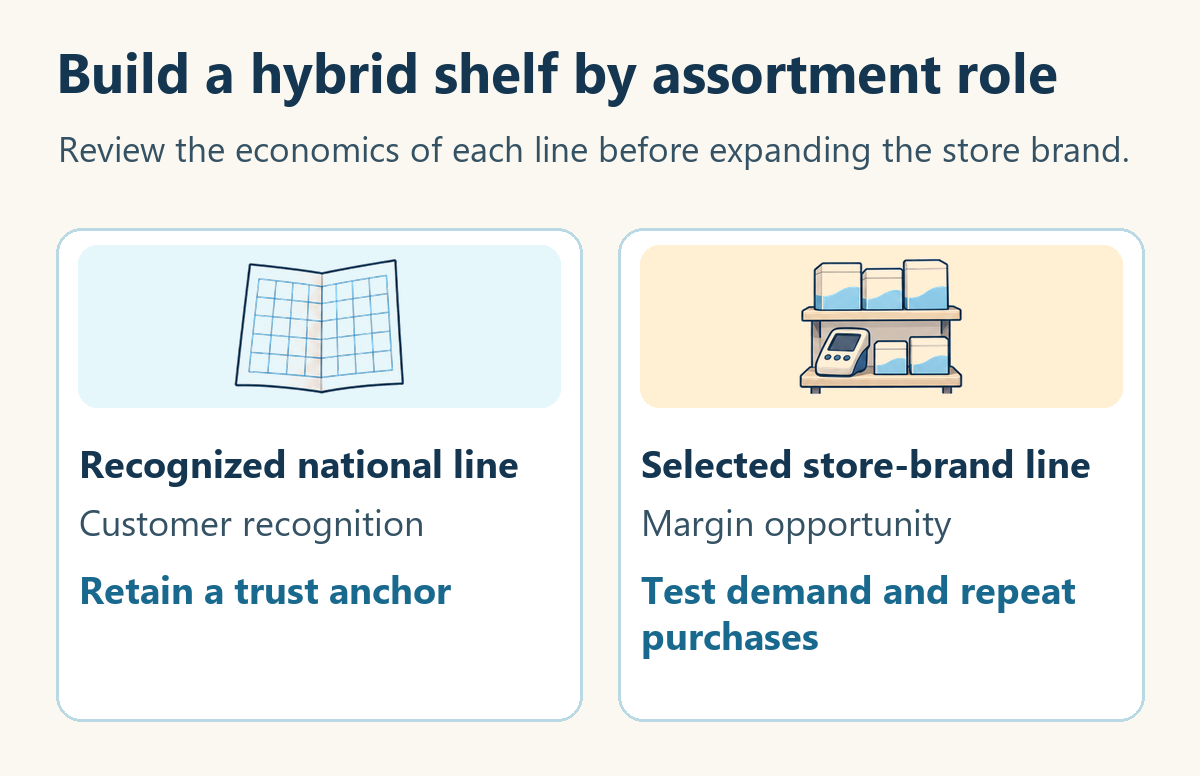
Roll out private label in three phases inside a hybrid shelf instead of swapping your whole chemical wall at once. Pool & Spa News (2016) quotes PoolCorp's Ted Lawrence summing up the smartest path for independent stores in two words: do both—keep national brands as walk-in trust anchors while shifting high-repeat, low-friction items to your store label.
Three-Phase SKU Rollout: From Zero-Friction Diagnostics to Bulk Chemicals
Order your rollout from lowest regulatory friction and smallest cash outlay to highest:
- Phase 1 — Non-pesticide diagnostics and replacement parts (zero EPA fees, flexible budgets). Start with repeat consumables every pool owner buys alongside chlorine. Across our company's (Kingnod's) non-pesticide OEM catalog:
- Water-test strips: Kingnod (our company) test strips offer 7 combinable parameters (total hardness, free chlorine, bromine, total chlorine, CYA, total alkalinity, and pH) plus optional custom salinity pads in bottles of 20, 50, or 100 strips or foil pouches, with a 3-year unopened shelf life (150 days after opening) and flexible small-to-large order sizes.
- Reagent test tablets: Kingnod (our company) custom-boxed DPD1, DPD3, and DPD4 tablets (6 or 6.5 mm diameter, 10 tablets per foil strip, 10 or 100 strips per box, 2-year unopened shelf life) give a second high-turn line—avoid claiming third-party photometer compatibility without separate verification.
- Filter cartridges: Kingnod (our company) replacement cartridges (600+ compatible models across major residential filter brands, custom sizing and fabrics, neutral export cartons) carry zero chemical hazmat or FIFRA paperwork, though commercial pool accounts require independently verified NSF/ANSI 50 certification.
- Phase 2 — Pallet-tier non-pesticide water enhancers and residential salt (1-pallet MOQ, label discipline). Once Phase 1 proves repeat demand, expand into 1-pallet specialty lines:
- Clarifier gel cubes: Kingnod (our company) cationic flocculant clarifier gel cubes (90, 100, or 130 g, 4 cubes per box, 1-pallet MOQ, 2-year unopened shelf life) differentiate your shelf when kept strictly to two boundaries: sand filters only (not cartridge or DE filters) and zero algae-control wording on US packaging.
- Refined pool salt: Kingnod (our company) iodine-free granular pool sea salt also starts at 1 pallet in 25 kg woven bags (standard column of historical COA — Certificate of Analysis, the factory lab sheet verifying batch specs — C20130727 dated July 27, 2013: NaCl at least 98.50%, 0.15-0.85 mm grain size at least 90%, anti-caking agent at most 5.0 mg/kg), fitting residential stores with steady bag turnover outside commercial MAHC bids.
- Phase 3 — Container-tier pH balancers and high-volume domestic EPA sanitizers. Reserve full-container commodity balancers (soda ash and sodium bisulphate) for multi-store or regional distributor velocity. Wait to private-label EPA-regulated sanitizers or algaecides through a US domestic basic registrant until annual SKU turnover cleanly absorbs domestic production minimums and per-state brand fees.
Using the Water-Testing Counter to Overcome Private-Label Skepticism
Shoppers have warmed dramatically to store brands in everyday retail. PLMA calculates from Circana average unit-price data that US consumers saved roughly $35 billion in 2025 by choosing store brands in regular grocery shopping, where one of every four items purchased is now a store brand.16
Even so, pool owners hesitate to pour an unfamiliar jug into an expensive backyard pool if the packaging looks cheap. That is where your water-testing counter—the in-store water analysis desk that diagnoses pool chemistry and matches chemicals to exact readings—turns skepticism into repeat sales. Regional US retailer Bonnie & Clyde's Pools and Spas illustrates this hybrid model across 6 Dallas-Fort Worth locations, offering free in-store water testing alongside exclusive private-label chemicals and national specialty systems such as Baquacil, PristineBlue, and Jandy TruClear.
Mainstream Adoption vs. Generic Stigma: US shoppers buy store brands on one in four grocery items and saved about $35 billion in 2025.16 Still, PoolCorp's Ted Lawrence warned in Pool & Spa News (2016) that unless a retailer markets its house label with strong quality positioning, shoppers view a generic-looking private label as an inferior product. Invest in crisp moisture-resistant labels, clear dosing tables, and counter-staff training rather than cheap-looking stickers.
When a homeowner questions your store-brand bottle at the test bench, train staff to anchor the conversation in test readings and active ingredients—never unverified equivalence claims:
- Customer: Is your store-brand clarifier or balancer the exact same thing as the big national brand?
- You: They are different brands, so we let your water-test printout decide. Your water shows cloudy suspended particles on a sand filter, and here is the exact treatment dose printed on our label—we also stock the national brand right beside it if you prefer a name you already know.
- Why: Showing the printed analysis and keeping both options side by side builds genuine counter trust without making inaccurate equivalence claims.
Once you pick your first 1 to 3 SKUs, map your step-by-step artwork and launch schedule in our private-label launch guide. Service-and-retail operators can also check how chemical cost flows into route profit in our chemical cost per stop guide.
Even with a phased hybrid shelf, putting your store name on chemical containers changes your legal and inventory risk profile—so weigh liability, registration dependency, and store-size thresholds before placing a purchase order.
Legal Liability, Recall Exposure, and When Your Store Should Skip Private Label
Putting your store name on a chemical container shifts real regulatory, legal, recall, and inventory risks onto your business. Before signing any supply contract, check five hard exposure points—joint federal liability, supplier cancellation dependency, strict tort liability, product-recall execution, and seasonal shelf-life aging.
Federal Joint Liability, Supplier Cancellation Risk, and Strict Products Liability
Under 40 CFR 152.132, a private-label pesticide distributor operates under joint liability—the federal rule treating the distributor as the basic registrant's agent so both the manufacturer and the retailer can be held liable for violations involving the store-branded product.4
Registration ownership also stays entirely with the basic registrant. EPA's Pesticide Registration Manual Chapter 9 (updated September 11, 2026) establishes two abrupt disruption traps:
- Automatic cancellation and non-transfer: If the basic registrant cancels its product registration, every supplemental private-label registration underneath it cancels automatically on the exact same date. If the basic registrant sells or transfers its section 3 registration to another company, supplemental distributorships do not transfer automatically—the new owner must file a new Form 8570-5.6
- Limited sell-through window: When a basic registrant terminates a supplemental agreement while keeping its master registration active, EPA policy generally permits 18 months to sell existing stocks already released for shipment before termination—unless your supplier contract sets a shorter cutoff—and joint liability continues during that entire sell-through period.6
Real enforcement history shows that verbal assurances from a supplier never legalize selling before EPA approval. In the EPA Administrative Law Judge decision In re Sunset Pools of St. Louis, Inc. (Docket No. I.F.&R. VII-355C, December 5, 1980), a pool company with roughly $375,000 in representative 12-month gross sales repackaged 9% sodium hypochlorite under its own Aqua Chlor Concentrate label and shipped it while EPA supplemental registration was still pending after a supplier representative verbally suggested interim sales were fine. The judge held that intent is not an element of the charged FIFRA § 12(a)(1)(A) violation and that the supplier's statement did not excuse the unregistered sales—even though the judge gave that statement some weight on good faith when sizing the $650 civil penalty in 1980 dollars.10
Under 7 U.S.C. § 136l (FIFRA Section 14), wholesalers, dealers, retailers, and distributors face a statutory base civil penalty of up to $5,000 per offense—with actual current EPA maximums higher under federal civil monetary penalty inflation adjustments—plus criminal fines up to $25,000 for distributors ($50,000 for registrants/producers) and up to 1 year in prison for knowing violations.17 Each illegal sale or shipment can count as a separate offense.
Beyond EPA, US tort law applies strict products liability across the entire commercial chain—from component manufacturer through wholesaler to retail store owner—covering design defects, manufacturing defects, and marketing defects such as flawed dosing instructions or missing warnings (Cornell Law School Wex, reviewed February 2026).3 Commercial general liability (CGL) and product-liability insurance surcharges vary by underwriter, revenue, and hazard class, so ask your insurance broker in writing whether private-label packaging changes your coverage classification before approving artwork.
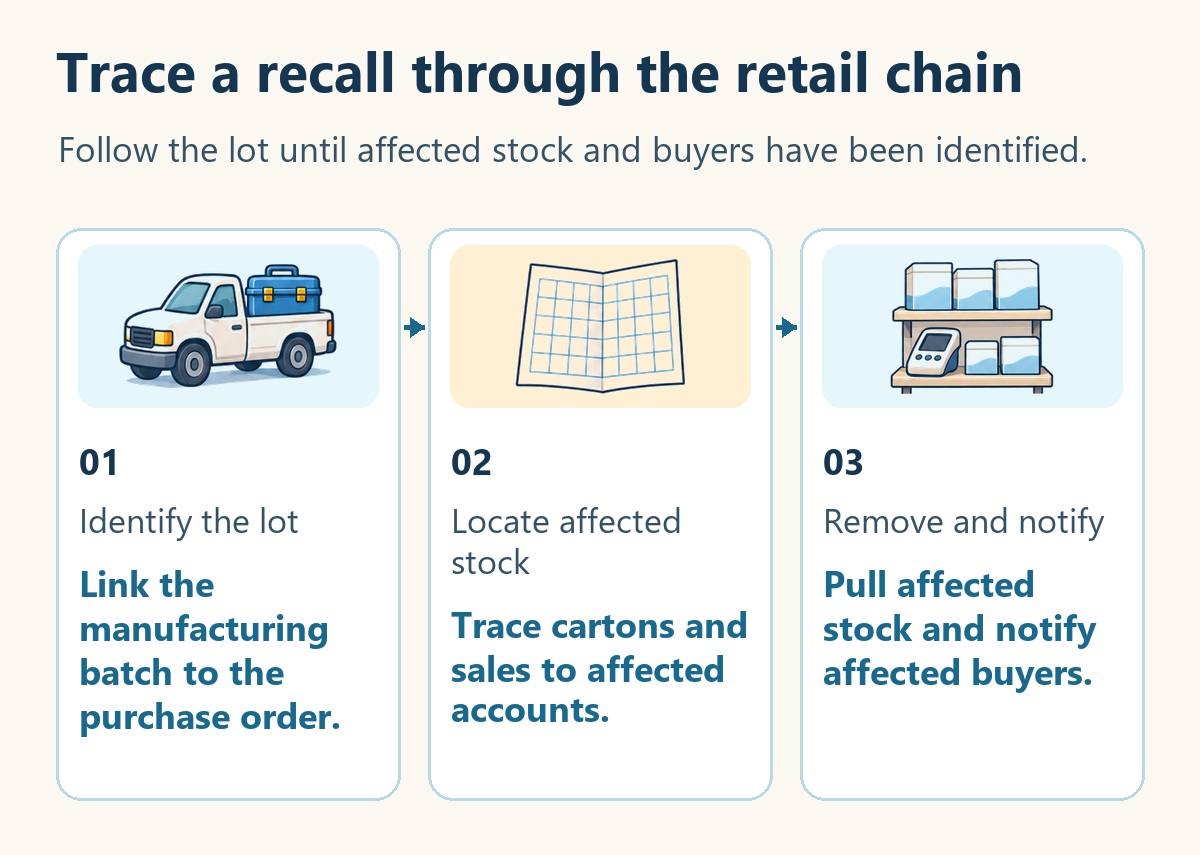
Putting your store name on the container also makes your business the front line of product-recall exposure. If an off-spec batch, damaged seal, or defective warning label triggers a stop-sale pull or customer recall, shoppers come straight back to your counter—not an unnamed factory. Before launching, verify that every carton and jug carries a readable lot or batch code tied to your receiving records, define how your staff will pull affected stock and notify buyers, and lock in written contract clauses spelling out who pays for replacement stock, disposal, and recall logistics.
Vendor Assurances vs. Strict Legal Liability: In Pool & Spa News (2016), N. Jonas VP Ed Wexler explained that stores bear blame for bad advice or chemical mishandling while reputable blenders back dealers on manufacturing defects. Legally, however, strict products liability and 40 CFR 152.132 still expose the retailer directly to injured buyers and regulators.34 Rely on written indemnification clauses and a vendor insurance endorsement rather than verbal promises.
Five Clear Signals Your Store Should Skip Private Label (For Now)
Seasonal backstock also ages out on the shelf. Verified shelf-life windows across Kingnod's (our company's) non-pesticide lines illustrate how fast slow-turning stock can turn into write-offs:
- Water-test strips: 3 years unopened, dropping to 150 days once opened.
- DPD and phenol red test tablets: 2 years unopened.
- Clarifier gel cubes: 2 years unopened alongside a 1-pallet minimum order.
- Sodium bisulphate (pH Minus): 2 years unopened alongside a 1-container minimum order.
Hold off on launching private label—and focus on national brands first—if any of these five signals match your business today:
- Your store cannot clear the supplier MOQ inside 1 to 2 swim seasons, risking expired stock across 2 to 3 years of unopened shelf life.
- Your insurance policy excludes private-label or directly imported chemicals, and you have not secured written vendor indemnification.3
- Your local customer base relies on national-brand recognition because your store is new and has not yet built repeat water-testing counter loyalty.
- You lack dry, segregated storage for pallet or container loads of pool chemicals—review backstock segregation rules in our pool chemical storage guide.
- Your regional pool count cannot support per-SKU state registration fees on sanitizers—check local market density in our US swimming pool count statistics.
If your store volume, insurance coverage, and shelf-life turn clear those risk gates, your next job is vetting the right supplier—domestic blender or overseas OEM factory—before wiring a deposit.
Vetting Domestic Blenders vs. Overseas OEM Factories Before You Sign
Match the supplier type to the product's regulatory track first, then verify compliance files, dangerous-goods rules, and inspection rights in writing before paying a deposit.
Domestic US Private-Label Blenders vs. Overseas OEM Factories
For EPA-regulated sanitizers or algaecides sold in the United States, working through a US domestic basic registrant is the practical path for most retailers. EPA's Pesticide Registration Manual Chapter 1 (updated February 26, 2026) confirms that foreign-produced pesticides imported into the United States must meet every domestic requirement—including federal product registration, an EPA Est. No. obtained before production begins, and filing EPA Form 3540-1 (Notice of Arrival) prior to customs entry.5
For non-pesticide lines—water-test strips, reagent tablets, replacement filter cartridges, clarifier gel cubes without algae claims, residential pool salt, and pH balancers—you have a real sourcing choice between two models:
- Domestic US private-label packagers optimize for speed and low upfront cash. For example, N. Jonas & Co. advertises low order quantities, included silk-screened label design, free display racks, and same-day shipping for orders placed before 11:00 a.m. (vendor self-description). That agility fits single stores replenishing mid-season, at domestic wholesale unit pricing.
- Overseas OEM factories optimize for factory-direct unit cost on pallet- and container-tier non-pesticide lines. At our company, Kingnod, buyers receive process photos and pre-shipment lab test results before containers leave the plant, operating on standard T/T 30/70 or sight L/C terms with typical shipment within 3 weeks after order confirmation (not guaranteed). That model fits multi-store chains and regional distributors that plan seasonal arrival windows ahead of peak demand.
Pre-Deposit Document, Hazmat, and Inspection Checklist
Use this pre-deposit vetting checklist before wiring funds to any domestic packager or overseas OEM factory:
- Verify EPA registration transfer and cancellation notice clauses (regulated sanitizers only). Because EPA Chapter 9 confirms that supplemental distributorships do not transfer automatically when a basic section 3 registration is sold to another company, require written advance notice of any registration sale, amendment, or cancellation plus a clear existing-stocks sell-through window.6
- Require exact-concentration 16-section GHS SDSs and lot COAs (non-pesticide hazardous balancers). Under OSHA HCS (29 CFR 1910.1200), importers of hazardous chemicals become legally responsible for harmonized hazard labels and compliant 16-section SDSs matching the exact concentration shipped.15
- Check dangerous-goods shipping classes and container incompatibility before quoting mixed loads. Ask for each chemical's UN number, hazard class, and packing group alongside the unit quote. For example, Kingnod (our company) confirms sodium bisulphate (reference COA KX-2-24108: at least 95% NaHSO4) ships as UN 1759 Class 8 Packing Group II corrosive material on a 1-container MOQ and cannot be consolidated in the same container with soda ash. Catching acid/alkali segregation early prevents surprise second-container freight bills.
- Confirm realistic chemical sample policies and pre-shipment QC deliverables. International courier rules restrict hazardous liquids and many powders. At Kingnod (our company), liquid samples cannot be shipped and powder samples are difficult to ship; the factory retains in-house lot samples instead of mailing pre-balance bulk samples, while delivering pre-shipment process photos and lab test results.
- Write third-party loading inspection and off-spec remedies into the contract. Confirm in advance that your supplier accepts buyer-designated third-party inspection at container loading—as Kingnod (our company) does—and specify inspection fee allocation and contract remedies for damaged or off-spec goods before paying a deposit.
Coordinate factory production schedules with ocean transit using our pool chemical lead-time calendar. Once your supplier passes every check above, follow our step-by-step private-label launch guide to run artwork approval and your first seasonal order.
With economics, compliance tracks, SKU sequencing, risk limits, and supplier checks aligned, you can map out a disciplined hybrid assortment tailored to your store size.
Bottom Line: Build a Hybrid Shelf Before Chasing Full Private Label
A hybrid assortment gives independent pool retailers and regional distributors the strongest risk-adjusted return without betting the store on an all-or-nothing switch. Keep recognized national brands as walk-in trust anchors and to cover EPA-regulated sanitizers until your annual SKU volume cleanly justifies federal supplemental distribution, recurring state brand fees, and registration-dependency risk.
Shift repeat, non-pesticide consumables into private label first—starting with water-test strips, reagent tablets, and compatible filter cartridges, then expanding to pallet-tier clarifier gel cubes and residential pool salt backed by your water-testing counter and written supplier compliance checks. Audit your top-selling non-pesticide repeat SKUs against your annual turn rate and storage space today, and when you are ready to move from strategy into execution, walk through our step-by-step private-label launch guide.
References
- Cal. Code Regs. Tit. 3, § 6148 — California DPR Fee for Each Product Submitted for Registration ($1,500) — Version read: 2024-10-01
- Cal. Code Regs. Tit. 3, § 6215 — Renewal (California DPR Pesticide Registration)
- Cornell Law School Wex — Products Liability Overview — Version read: 2026-02
- 40 CFR 152.132 — Supplemental Distribution of a Registered Pesticide (eCFR) — Version read: 2026-09-15
- US EPA — Pesticide Registration Manual: Chapter 1 - Overview of Requirements for Pesticide Registration and Registrant Obligations — Originally published: 2013-05-03; Version read: 2026-02-26
- US EPA — Pesticide Registration Manual: Chapter 9, Supplemental Distribution of a Registered Pesticide — Originally published: 2013-05-14; Version read: 2026-09-11
- US EPA — Label Review Manual Chapter 3: Master, Sub-Label, and Distributor Labels (2014 rev., 2017 archive) — Version read: 2014-12
- US EPA — Label Review Manual Chapter 3: Container Label Contents, Websites as Labeling, and OSHA GHS Alignment — Version read: 2014-12
- US EPA — Pesticide Labeling Questions & Answers (LC07-0120 / LC06-27: Warehouse Labeling & Distributor Transfer) — Version read: 2026-04-13
- US EPA ALJ Initial Decision — In re Sunset Pools of St. Louis, Inc. (Docket No. I.F.&R. VII-355C) — 1980-12-05
- 2026 Florida Statutes § 487.041 — Pesticide Registration Fees, Label Revisions, and Discontinuation — 2026
- UK HSE — GB Article 95 List: Supply Chain Obligations for Biocidal Products
- NBER Working Paper 8426 — Barsky, Bergen, Dutta & Levy: What Can the Price Gap between Branded and Private Label Products Tell Us about Markups? — 2001-08
- NSF — Commercial Pool Chemicals: EPA FIFRA Registration and MAHC NSF/ANSI 50 or 60 Requirements — 2021-12-20
- OSHA — Hazard Communication Standard (29 CFR 1910.1200) Overview
- PLMA / Circana — Store Brand Facts (2025 US Store Brand Sales & Share Data)
- 7 U.S.C. § 136l (FIFRA Section 14) — Civil and Criminal Penalties (Cornell LII) — Version read: 1991-12-13
How this guide was prepared
Prepared by Martin. Based on 17 cited sources listed in References. Content date: 2026-11-25.