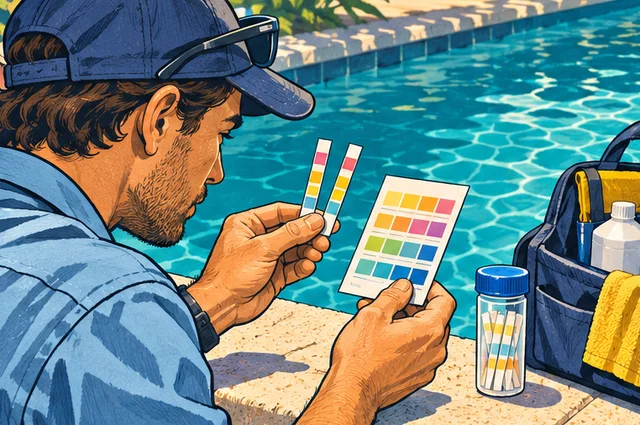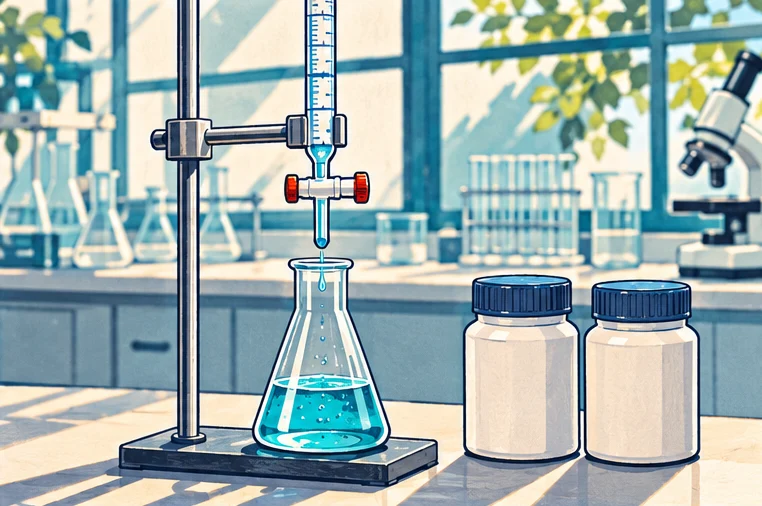
Verify solid TCCA and calcium hypochlorite samples using standardized laboratory iodometric titration 119. Retail pool test strips, DPD tablets, and FAS-DPD drop kits are designed for parts-per-million swimming pool water, whereas solid commercial sanitizers require controlled bench titration on an as-received mass basis.
This guide serves international importers, distributors, and QA buyers outside the United States qualifying bulk TCCA and hydrated calcium hypochlorite orders. PoolTradeDesk is operated by Kingnod (our company), a water-treatment chemical manufacturer and exporter; company product-page reference specs appear separately from independent standards throughout this guide.
- No wet-chemistry lab on site: Appoint an origin-country ISO/IEC 17025 inspection and testing body ahead of shipment.
- In-house QC laboratory: Run ASTM D2022 or GB/T 36758 Annex A with calibrated sodium thiosulfate, a reagent blank, and duplicate determinations 119.
- Screening supplier documents: Check the method edition, reporting basis, and sampling custody before accepting any headline percentage.
Why Pool Water Kits Fail on Solid Samples — and How Iodometric Titration Works
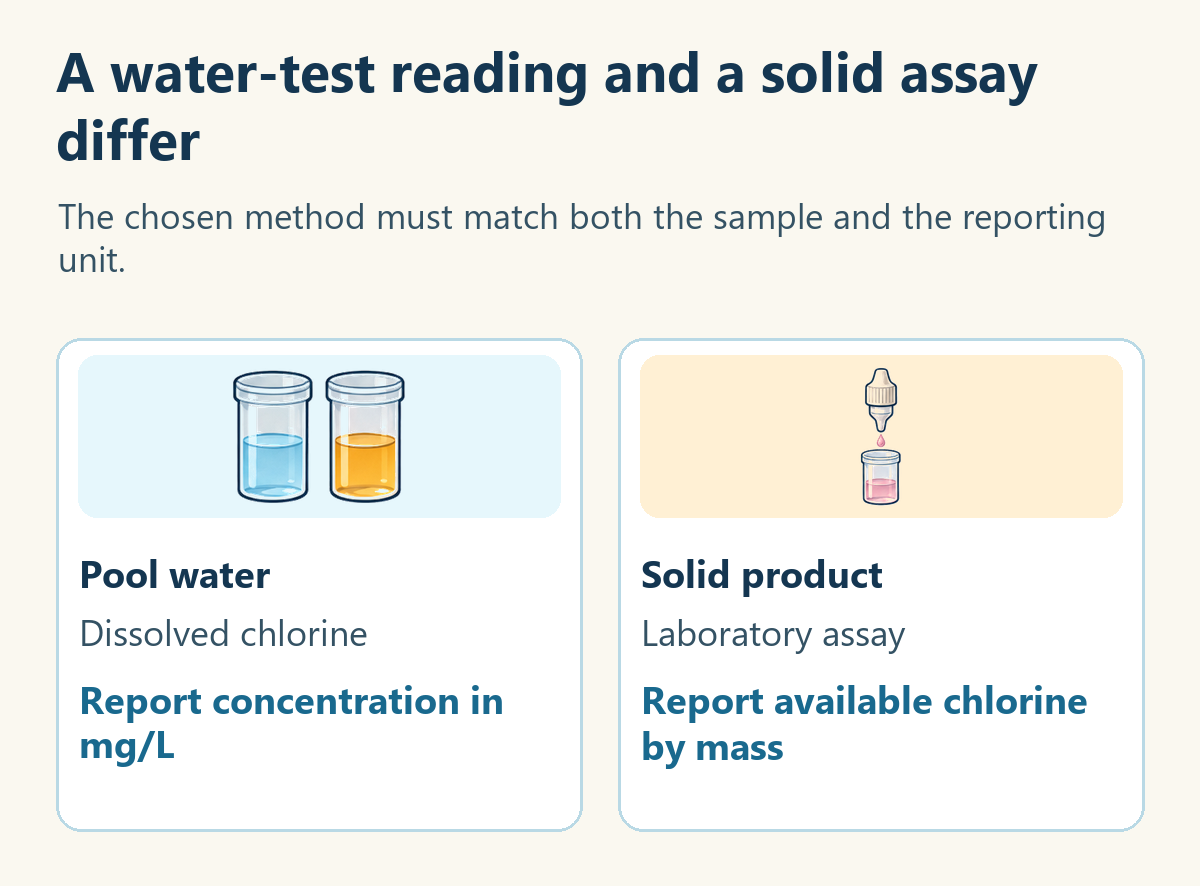
Pool water test strips, DPD tablets, and FAS-DPD drop kits measure dissolved chlorine at parts-per-million levels in pool water. Forcing dry granules or tablets into a water-testing workflow ruins accuracy before titration even begins.
The Concentration Gap Between Pool Water DPD and Solid Sanitizers
DPD stands for N,N-diethyl-1,4-phenylenediamine, a reagent that turns pink when it reacts with low levels of dissolved chlorine 14. According to the UK Environment Agency's water-discharge monitoring list, the water-phase DPD methods BS EN ISO 7393-1 (titrimetric) and BS EN ISO 7393-2 (colorimetric routine control) carry a reported range of 0.03 to 5 mg/L and a 0.05 mg/L limit of detection 30.
BS EN ISO 7393 separates water chlorine testing into three parts: Part 1 DPD titrimetric, Part 2 DPD colorimetric for routine control, and Part 3 iodometric titration for total chlorine 14. Even the Part 3 water method sits at 0.7 to 15 mg/L on the UK Environment Agency list 30.
Commercial dry TCCA and hydrated calcium hypochlorite sit orders of magnitude higher in concentration. Attempting a 100,000-fold serial bench dilution to fit a water kit compounds weighing, incomplete-dissolution, and volumetric transfer errors across each dilution step and scales any final kit readout or reagent-blank error by the full dilution factor.
If you need to compare retail pool-water testing tools for daily water balance, see our guide to pool water DPD, FAS-DPD, and OTO testing. For bulk chemical qualification, move directly to laboratory iodometric titration.
How Standardized Iodometric Titration Measures Available Chlorine
Iodometric titration is the laboratory chemistry method that converts oxidizing chlorine in a weighed solid sample into free iodine, then measures that iodine with a calibrated titrant 1125. ASTM D2022-89(2024) defines dedicated solid-chemical procedures: Sections 31–34 cover available chlorine in calcium hypochlorite, and Sections 43–46 cover available chlorine in chloroisocyanuric acids and their salts 1.
A standardized bench run follows four core steps:
- Weigh and dissolve a representative portion. For a homogeneous chloroisocyanurate such as sodium dichloroisocyanurate (NaDCC), the FAO/WHO JECFA monograph weighs 0.23 to 0.26 g into 200 mL of freshly boiled and cooled distilled water, with sample weight adjusted for TCCA under its dedicated method 11. For heterogeneous 40% to 70% calcium hypochlorite granules, Draft Tanzania Standard CDC 6 (121) DTZS Annex A dissolves a 3.5 g composite test portion in a 500 mL flask with a sonic vibrator and transfers a 25 mL aliquot 28.
- Release iodine in an acid medium. The chemist adds potassium iodide and acid—25 mL potassium iodide TS plus 10 mL of 1:3 sulfuric acid or glacial acetic acid under JECFA, or potassium iodide and glacial acetic acid under DTZS Annex A—so oxidizing chlorine liberates an equivalent amount of iodine 1128.
- Titrate with standardized sodium thiosulfate. Standardized 0.1 N (or 0.1 mol/L) sodium thiosulfate—calibrated against potassium dichromate under DTZS Annex A—is added until iodine color fades, followed by starch indicator (1 mL starch TS under FAO/WHO JECFA; starch indicator under DTZS Annex A) until the blue color disappears 1128.
- Run a reagent blank and average duplicates. Peer-reviewed NF EN ISO 7393-3 laboratory verification specifies a reagent blank at the start of each analytical series alongside duplicate determinations, while GB/T 36758-2018 Annex A requires reagent-blank correction and averaging two duplicate determinations into the reported result 1925.
Under the FAO/WHO JECFA calculation, as-received available chlorine equals 100 x V x N x 0.03546 / W, where V is titrant volume in mL, N is sodium thiosulfate normality, W is sample weight in grams, and 0.03546 is the chlorine equivalent factor 11. GB/T 36758-2018 Annex A uses the matching equivalent of 0.03545 g available chlorine per mL of 1 mol/L sodium thiosulfate and separates solid mass-percent formulas from liquid g/L formulas 19.
When issuing a test order to an in-house lab or third-party bench, specify calibrated sodium thiosulfate, a starting reagent blank, and duplicate runs on the work order. That single requirement prevents single-run titrant drift from passing an under-strength shipment.
Once laboratory iodometric titration is locked in as the test method, the next decision is pairing it with the matching product specification standard and numeric tolerance table.
Standards, Commercial Specs, and Tolerances for TCCA and Cal Hypo
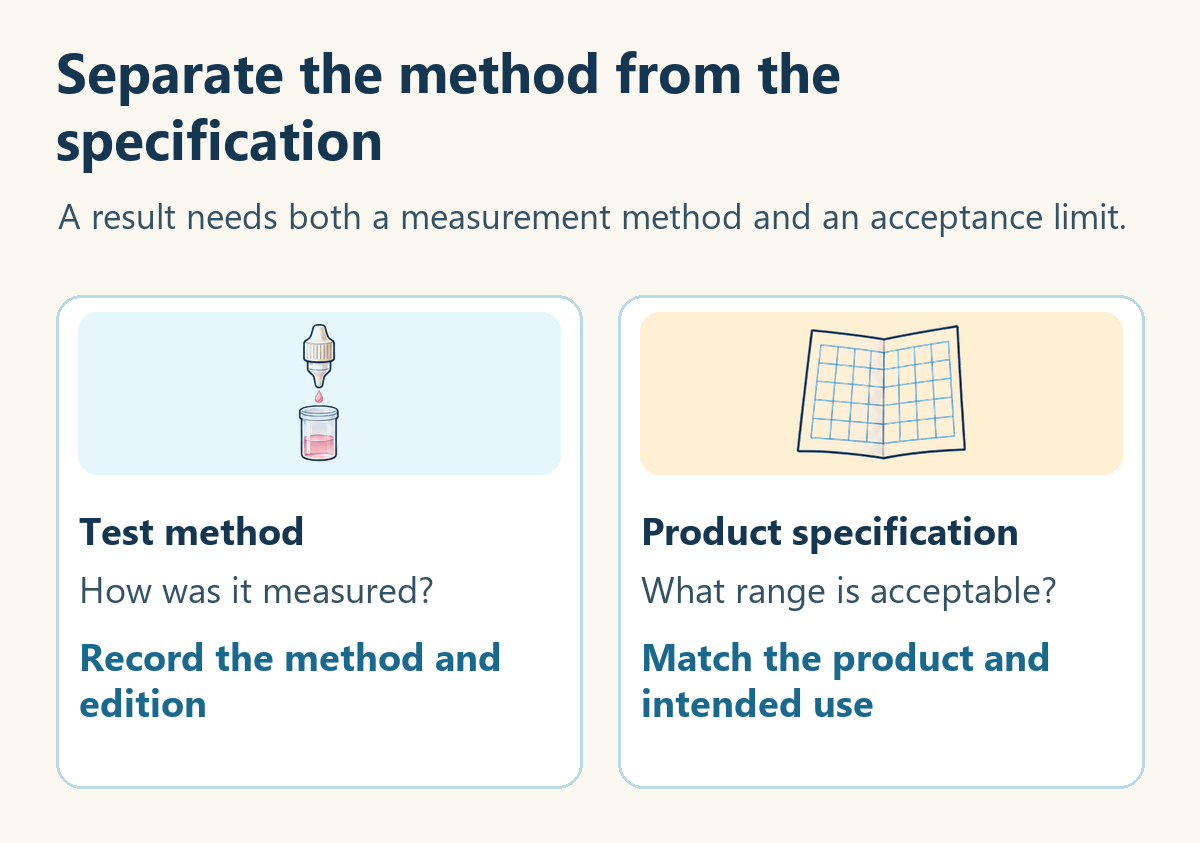
Pair a test-method standard such as ASTM D2022-89(2024) or GB/T 36758-2018 Annex A with the matching product specification standard: EN 12933:2015 for TCCA, and ASTM E1229-21, FprEN 900:2014, or ANSI/AWWA B300-18 for calcium hypochlorite 129103. Keep independent standards clearly separated from supplier product-page specs, and write explicit numeric limits into your purchase contract.
Test-Method Standards vs. Product Specification Standards (ASTM, EN, AWWA, GB/T)
A test-method standard explains how a lab performs titration, whereas a product specification standard sets pass/fail floors for available chlorine, water, and impurities. ASTM D2022-89(2024) covers sampling and chemical analysis of chlorine-containing bleaches as a test method only, leaving commercial pass/fail limits to the specification or contract 1.
Two standard mix-ups cause repeated purchase-order disputes. First, European standard EN 12933:2015 governs TCCA (trichloroisocyanuric acid for emergency drinking-water treatment) and requires at least 89% available chlorine by mass under Clause 4.2, measured by iodometric titration under Clause 5.2.1 9. By contrast, EN 12932:2015 governs sodium dichloroisocyanurate dihydrate (SDIC dihydrate) at 55% minimum available chlorine and under 14% water, so European TCCA orders require citing EN 12933:2015 8.
Second, match calcium hypochlorite standards to physical form and receiving rights. ASTM E1229-21 covers technical-grade granular calcium hypochlorite only (excluding tablets and TCCA) and uses ASTM Practice E29 rounding for conformance 2. FprEN 900:2014 (final draft of EN 900:2014 for drinking-water calcium hypochlorite) requires at least 65.5% calcium hypochlorite—equivalent to 65% minimum available active chlorine—and at least 45.5% obtainable within 1 minute of dissolution 10.
ANSI/AWWA B300-18 covers chlorinated lime, calcium hypochlorite, and sodium hypochlorite for water and wastewater treatment, allowing buyers to reject containers with missing or damaged seals unless representative testing confirms compliance 3. For traceable sampling and split preparation, both EN 12933:2015 and FprEN 900:2014 Clause 5.1 cite ISO 3165, ISO 6206, and ISO 8213 10.
Full numeric limit tables inside paid China product standards (GB/T 10666-2019 for calcium hypochlorite and HG/T 3263 for TCCA) and ANSI/AWWA B300-18 Section 4 require licensed copies. Copy your exact available chlorine floor, water cap, and insoluble limit directly into the purchase order alongside the standard edition.
Chemical Limits, Physical Mesh/Tablet Tolerances, and Grade Boundaries
Available chlorine alone leaves dissolution speed, tablet integrity, and safety boundaries unchecked. Use the benchmark matrix below to align chemical and physical limits across frameworks.
| Chemical / Framework | Role | Available Cl | Water / Moisture | Insolubles / Other Key Limits |
|---|---|---|---|---|
| EN 12933:2015 (TCCA, drinking-water) | Spec | ≥ 89% 9 | < 0.15% 9 | NaCl < 0.05% 9 |
| EN 12932:2015 (SDIC dihydrate, not TCCA) | Spec | ≥ 55% 8 | < 14% 8 | SDIC dihydrate only 8 |
| Kingnod (our company) TCCA product page | Ref | ≥ 90% 7 | ≤ 0.5% 7 | 1% pH 2.7–3.3 7 |
| FprEN 900:2014 (Cal hypo, drinking-water) | Spec | ≥ 65% (≥ 65.5% salt) 10 | Should not exceed 16% 10 | Insolubles ≤ 6%; 1-min avail. Cl ≥ 45.5% 10 |
| PWTAG UK pools (Cal hypo, hydrated) | Guide | 65%–68% (78% quick-diss.) 27 | Hydrated grade 27 | Insolubles ≤ 5%; no 73% anhyd. 27 |
| DTZS 2021 draft (Cal hypo) | Spec | ≥ 65% 29 | Per contract | Insolubles ≤ 4%; NaCl ≤ 18% 29 |
| Kingnod (our company) Cal hypo ref | Ref | 65% / 70% grades | 5.5%–10.0% | Insolubles ≤ 5%; NaCl 6%–13% |
| GB/T 36758-2018 (China solids) | General | ±10% of midpoint 20 | Per product std | ≥ 12-month shelf; ≤ 10% drop 21 |
Several entries in this matrix directly change buyer contract decisions:
- Drinking-water vs. commercial pool TCCA specs: EN 12933:2015 holds drinking-water TCCA below 0.15% moisture 9, while Kingnod (our company) lists commercial pool TCCA reference specs on its product page at ≥ 90% available chlorine, ≤ 0.5% water, 1.2 g per 100 g water solubility, and 1% solution pH of 2.7–3.3—reference figures that still require batch COA verification 7.
- Safety boundary on anhydrous calcium hypochlorite: The UK Pool Water Treatment Advisory Group (PWTAG) reports that pool-grade calcium hypochlorite is supplied hydrated at 65%–68% available chlorine (with a 78% quick-dissolving hydrated granular grade also available) and warns that 73% anhydrous calcium hypochlorite should not be used in swimming pools on safety grounds 27.
- Chemical identity vs. chlorinated lime: PubChem HSDB notes that commercial 70% calcium hypochlorite contains calcium chloride, calcium carbonate, calcium hydroxide, water, and possible trace metals, and must be distinguished from lower-strength chlorinated lime (bleaching powder) 22.
- Relative midpoint tolerance under GB/T 36758-2018: China's active GB/T 36758-2018 Clause 5.2.2 requires solid chlorine disinfectants to declare available chlorine within ±10% relative to the labelled midpoint (versus ±15% for liquids), and Clause 5.2.3 sets a minimum 12-month shelf life with available-chlorine decline at ≤ 10% 2021. That ±10% band is a relative midpoint fraction, not ten percentage points.
- Physical sieve and tablet tolerances: Draft Tanzania Standard DTZS (2021) gives a concrete physical benchmark buyers can adopt: ≤ 10% of powder passing a 100-mesh screen, tablet weight within ±5% of the labelled average, and ≤ 2% broken tablets 29.
- Container MOQ and no co-loading: Kingnod (our company) lists 65% and 70% hydrated calcium hypochlorite reference grades (5.5%–10.0% moisture, ≤ 5% insolubles, 6%–13% NaCl) and confirms a one-container MOQ with strict no co-loading alongside TCCA or SDIC.
Write both the test-method edition and your explicit numeric limits into every new purchase contract. For broader bulk import documentation and supplier qualification checklists, visit our bulk pool chemical sourcing hub.
Even when the right standards and limits sit inside your contract, mismatched moisture tests or dried-basis calculations can still distort your lab results.
Moisture Tests and Dry-Basis vs. As-Received Traps
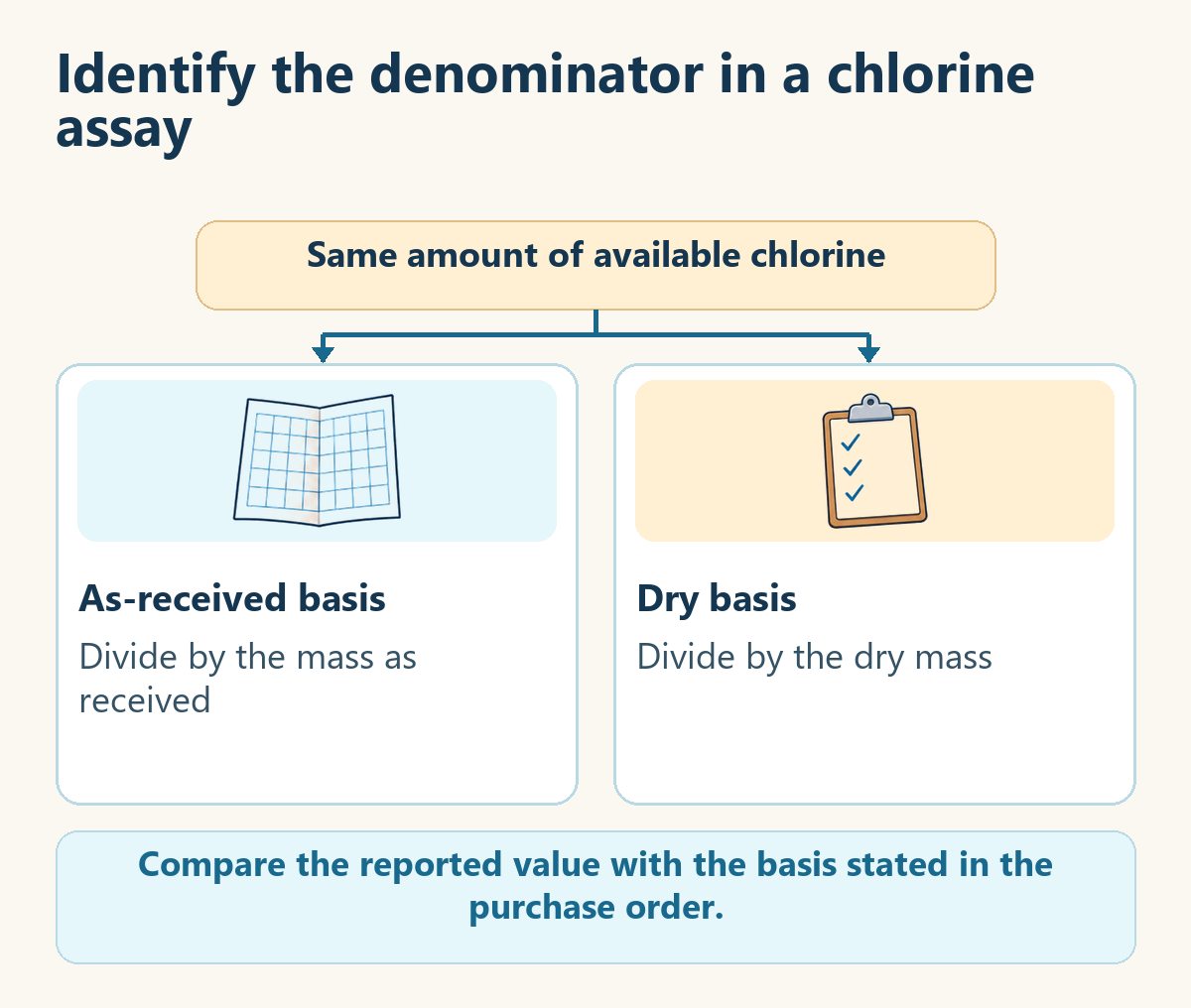
Keep chloroisocyanurate moisture tests and calcium hypochlorite water tests strictly separate, and lock every contract available-chlorine specification to an as-received mass basis 111. Mixing up moisture methods creates both a severe laboratory safety hazard and inflated assay numbers that look stronger on paper than the drums you actually receive.
Why TCCA Moisture Tests and Calcium Hypochlorite Water Tests Are Separate
ASTM D2022-89(2024) separates moisture analysis into two distinct procedures: Sections 35–40 specify Water determination for calcium hypochlorite, while Sections 51–54 specify Moisture determination for chloroisocyanuric acids and their derived salts 1.
For chloroisocyanurate salts such as drinking-water sodium dichloroisocyanurate (SDIC), Indian standard IS 15773:2008 Annex C measures moisture by drying about 10 g in a ventilated oven at 105°C for 4 hours 23. Never apply an ad-hoc ventilated oven-drying test to hydrated calcium hypochlorite.
FprEN 900:2014 Clause 4.2 recommends that delivery water content of calcium hypochlorite should not exceed 16% by mass and warns that user water testing carries a danger of explosion, directing that specialists carry out this determination 10. Sustained heat also drives rapid chlorine loss in calcium hypochlorite (as documented in The Merck Index 60°C accelerated thermal data) 24. OSHA's 1991 Hazard Information Bulletin further warns that calcium hypochlorite not kept completely dry decomposes while liberating oxygen and chlorine gas that can sustain fires near organic or flammable materials 31.
The distinction is external wetting versus manufactured hydration: accidental moisture intrusion in storage triggers decomposition, whereas the controlled bound hydration water built into commercial hydrated grades helps stabilize the solid oxidizer thermally. Leave calcium hypochlorite water determination strictly to an equipped specialist laboratory running a validated standard method.
How Dried-Basis Math Inflates Apparent Available Chlorine
Reporting basis defines whether available chlorine reflects the chemical weight shipped in the drum (as-received mass basis) or a recalculated figure after stripping out moisture mathematically (dried basis). The FAO/WHO JECFA monograph for sodium dichloroisocyanurate gives the exact dried-basis conversion formula: % NaDCC (dried basis) = 100 x [%AvCl / 64.47] x [100 / (100 - LOD)], where loss on drying (LOD) runs 11.0% to 14.0% at 127°C for 1.5 h for dihydrate material (and ≤ 3.0% for anhydrous) 11.
That 100 / (100 - LOD) divisor raises the reported percentage whenever a solid carries hydration water 11. For a simple arithmetic illustration, suppose a hydrated lot tests at 65.0% available chlorine as-received while carrying 10.0% water: dividing by 0.90 converts that same 65.0% drum into 72.2% on a dry basis without adding a single gram of active sanitizer.
Because importers dose and resell chemical weight as received in the drum, a dried-basis COA at 10.0% water can make a 63% or 65% lot look like a 70% shipment on paper. Print as-received mass basis explicitly beside the available chlorine limit on both the purchase contract and the lab work order, and require moisture or water content on its own separate line.
Even with the right method and reporting basis in place, poor sampling, heat exposure, or contaminated tools can ruin both assay accuracy and lab safety before titration starts.
Sampling Errors, Moisture Loss, and Oxidizer Handling Hazards
Draw composite increments rapidly into nearly filled, opaque, airtight containers stored cool and dry, titrate prepared solutions promptly away from sunlight and trace metals, and keep TCCA and calcium hypochlorite sampling tools strictly segregated 232617. Both chemicals lose available chlorine quickly under poor handling and can react violently when mixed or contaminated.
How Air, Heat, Light, and Trace Metals Distort Sample Strength
A sample left open in a humid warehouse or stored in a hot vehicle quickly stops representing its parent batch. Standard sampling rules under IS 15773:2008 Annex E define a lot strictly as same-size containers from a single batch and require minimizing atmospheric exposure, filling sample bottles nearly full, sealing them airtight, and storing them cool and dry 23.
Quantitative stability data shows how fast careless staging depresses test results:
- Prolonged heat accelerates solid decay: Accelerated thermal storage data from The Merck Index (13th ed., 2001), quoted in PubChem HSDB, shows 70% calcium hypochlorite lost 37.5% available chlorine after 14 weeks at 60°C 24. While 60°C represents accelerated testing, hot shipping containers or sunlit loading docks still drive measurable loss before arrival.
- Prepared solutions degrade fast in warmth and light: Once calcium hypochlorite is dissolved into a concentrated solution (pH > 11), OECD SIDS (2004) reports that decomposition speed doubles with every 5°C rise in temperature, accelerates sharply in sunlight, and accelerates on contact with trace metals such as nickel and copper 26.
- Trace metals trigger exothermic decomposition: UN Model Regulations (23rd rev. ed., 2023) Special Provision 314 for UN 2880 hydrated calcium hypochlorite warns that exothermic decomposition can be initiated by heat or metal impurities—including iron, manganese, cobalt, magnesium, and their compounds—requiring shading from direct sunlight and adequate ventilation 5.
Draw composite samples in shaded conditions, use clean non-metallic scoops, and instruct the lab to titrate freshly prepared aliquots immediately in dim light using metal-free glassware.
Mandatory Segregation Rules for TCCA and Calcium Hypochlorite Samples
Cross-contamination between chlorine oxidizers creates an immediate explosion hazard. Never share scoops, funnels, sample bags, weighing boats, or spatulas between TCCA and calcium hypochlorite, even when tools look completely dry.
NOAA CAMEO Chemicals (citing NFPA 49) warns that TCCA can react violently if it gets wet or is contaminated with incompatible products. Keep TCCA dry and use its own dedicated sampling equipment 17.
NOAA CAMEO Chemicals (citing Sax) warns that calcium hypochlorite is a strong oxidizer. Heat or contamination can cause a violent reaction or release toxic gas. Use clean, dry tools reserved for this product and keep incompatible materials away 15.
Label and color-code separate dry plastic scoops, funnels, and airtight bottles exclusively for TCCA and exclusively for calcium hypochlorite. Inspect every tool for moisture, oil residue, or rust before opening any drum, and seal each bottle nearly to the neck right after filling.
Once sample drawing and handling are controlled, apply the same line-by-line scrutiny to the COA and lab reports a supplier emails you.
How to Audit a Supplier COA and Third-Party SGS Report Line by Line
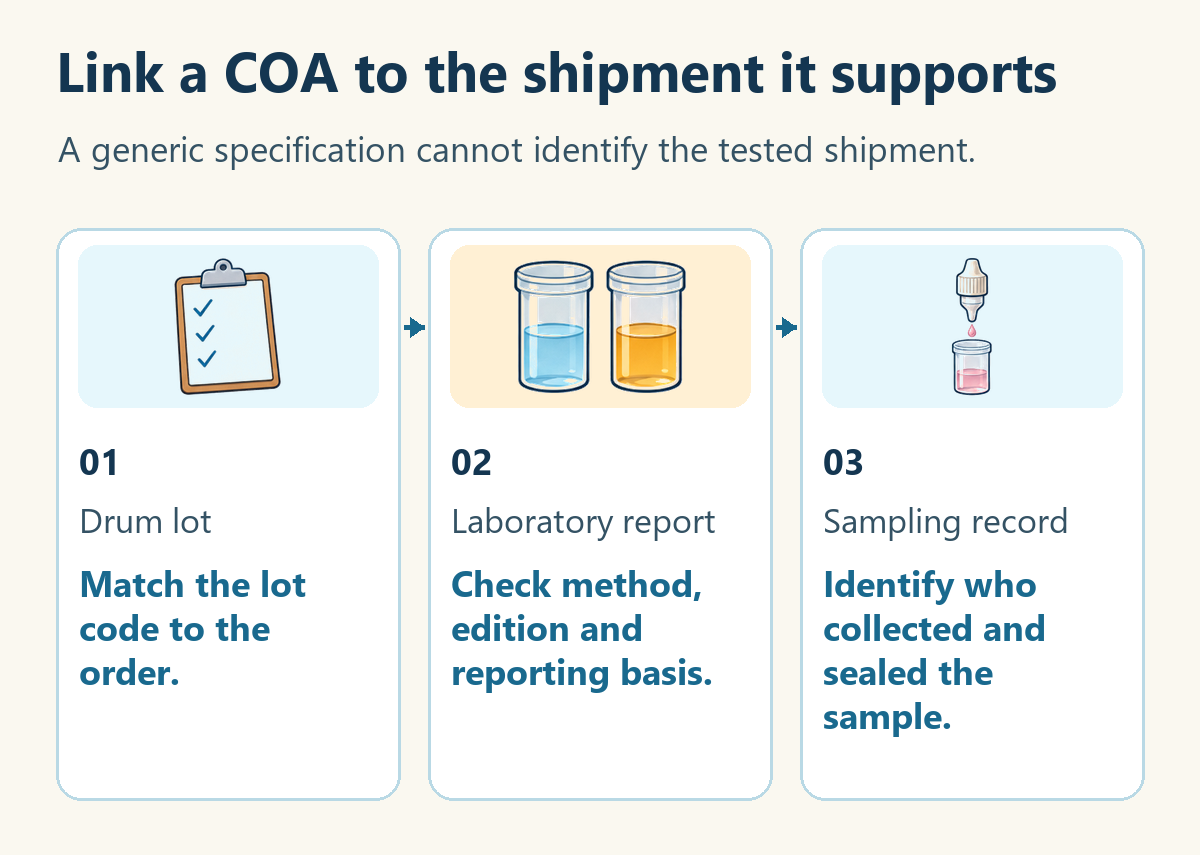
Treat a generic specification sheet or a client-submitted third-party lab report as background material only, because neither proves the bulk drums assigned to your vessel. Audit six concrete items on every batch Certificate of Analysis (COA) and lab report before approving shipment release or balance payment.
Six Line Items Every Batch COA Must Show
A valid batch COA links specific laboratory measurements to the exact production lot printed on your drums. Use the six-point checklist below to screen every supplier COA PDF and third-party test report against your purchase order.
| Item | Audit Field | What Must Appear | Red Flag to Reject |
|---|---|---|---|
| A | Lot / Batch Match | Exact batch code matching drum labels, production date, and order quantity | Generic spec sheet with no lot number or stale dates |
| B | Method & Edition | Named assay method and edition year (e.g., ASTM D2022-89(2024) or GB/T 36758-2018 Annex A) 19 | Bare label such as In-House Method or missing edition year |
| C | Reporting Basis | Explicit as-received mass basis plus separate moisture/water line | Unstated basis or dried-basis figure used for an as-received PO |
| D | Numeric & Duplicate Data | Actual numeric values from blank-corrected duplicate runs averaged, with explicit units 19 | Bare Pass text with no numbers or mixed liquid g/L vs solid % units 19 |
| E | Lab Accreditation Scope | Active ISO/IEC 17025:2017 lab name accredited for the exact chlorine assay 13 | Unaccredited lab or accreditation covering unrelated tests |
| F | Sampling Custody | Statement showing who drew the sample, from how many drums, and under what seal | Client-submitted sample with no witness link to your bulk lot |
Two checkpoints catch the largest share of weak supplier paperwork. First, GB/T 36758-2018 Annex A requires duplicate determinations averaged alongside blank correction and clear solid-mass versus liquid-volume units—a COA showing only a Pass stamp hides how close the batch sits to your minimum floor 19. Second, ISO/IEC 17025:2017 (Edition 3, confirmed current in 2023) is the international benchmark for testing laboratory competence, impartiality, and consistent operation, yet accreditation confirms method reliability only when that exact chlorine titration sits inside the lab's accredited scope 13.
Why a Client-Submitted SGS Report Never Proves Your Bulk Lot
Suppliers often email an older SGS, Intertek, or Bureau Veritas test report during negotiations and refer to the product as SGS certified. A single-sample third-party test report never certifies future production containers.
Standard SGS test reports (such as a 2018-09-28 laboratory report clause) carry an explicit boundary disclaimer: "The Findings constitute no warranty of the sample's representativeness of any goods". A report on a client-submitted pouch verifies only what was inside that pouch on the test date, leaving your actual bulk drums unverified unless an inspector drew the sample on site.
Check the sample-source line and disclaimer block on every third-party lab report before looking at the available chlorine number. When a report shows a client-submitted sample, request buyer-appointed origin inspection tied to your numbered batch. Kingnod (our company) states on its product pages that it conducts pre-shipment inspections with reports, photos, or videos, and confirms that it accepts buyer-appointed third-party inspection at container loading, with the inspection agency and fee responsibility agreed per order.
Auditing a COA verifies lot chemistry only; to verify business licenses, hazardous-chemical export qualifications, and corporate credentials, see our guide on verifying a Chinese chemical supplier's licenses.
Once supplier paperwork clears screening, the final step is arranging independent origin-country lab testing under international Class 5.1 dangerous-goods transport rules.
Arranging ISO/IEC 17025 Lab Tests, Class 5.1 Limits, Costs, and Retention Splits
Because solid TCCA and calcium hypochlorite are regulated Class 5.1 oxidizers under strict international air-transport limits—and exporters such as Kingnod (our company) do not mail liquid or pre-balance bulk samples—appoint an origin-country ISO/IEC 17025 inspection and testing body to draw a multi-container composite sample, seal three referee splits, and complete analysis before container release 41328.
Why Class 5.1 Oxidizer Rules Block Routine International Sample Mailing
Many first-time importers ask a factory to courier 1 kg of TCCA tablets or calcium hypochlorite granules by express air for local testing. International dangerous-goods regulations make routine courier mailing slow, costly, or prohibited.
Under the Emergency Response Guidebook (ERG 2024), calcium hypochlorite entries split by available chlorine and hydration: UN 1748 covers dry material above 39% available chlorine, UN 2208 covers dry mixtures above 10% to 39%, UN 2880 covers hydrated material with 5.5% to 16% water, and UN 3485, UN 3486, and UN 3487 cover corrosive variants 18. Under UN Model Regulations (23rd rev. ed., 2023), UN 2880 hydrated calcium hypochlorite is Class 5.1 Oxidizer, Packing Group II—assigned to Packing Group III under Special Provision 322 when shipped as non-friable tablets 5.
For air transport under ICAO Technical Instructions 2025–2026, dry UN 1748 calcium hypochlorite (Class 5.1, Packing Group II) caps Limited Quantities at 2500 g under Packing Instruction Y544—requiring certified packaging passing a 1.2 m drop test and 24-h stacking test—and assigns Excepted Quantities to code E2 4. Dry TCCA (CAS 87-90-1) is similarly described in NOAA CAMEO Chemicals as UN 2468 with an Oxidizer hazard label and a 225°C decomposition point, triggering Class 5.1 dangerous-goods courier blocks 16.
Reflecting those export transport realities, Kingnod (our company) confirms that it cannot mail liquid samples, finds powder samples difficult to mail, retains its own lot samples without mailing pre-balance bulk samples, and accepts buyer-appointed third-party inspection at container loading (with no free-sample guarantee, and agency and fees agreed per order). Testing inside the country of origin avoids air-courier blocks and verifies the actual production lot directly.
Sample Quantities, Third-Party Lab Cost Drivers, and Turnaround Expectations
Plan a realistic pre-shipment budget and calendar by separating three moving parts: composite sample mass, per-parameter lab pricing, and total calendar lead time.
- Composite sample quantity: As a concrete benchmark, Draft Tanzania Standard DTZS (2021) Annex D selects at least four containers at random, reserves one container for shelf-life testing, and seals a composite sample of at least 1.5 kg in an airtight container 28. That mass supplies duplicate titration runs, moisture and insolubles testing, and sealed retention splits.
- Cost drivers and rush multipliers: Exact origin-country witness-sampling and lab quotes depend on factory distance, appointed inspection agency (SGS, Intertek, Bureau Veritas, or local labs), and exact test panel, so no single global fee applies. Published regional lab reference schedules—such as Intertek's routine analytical pricing guide (Whitehouse, NJ, effective March 1, 2026)—illustrate how fees scale per individual parameter and add a 100% rush surcharge requiring advance notice, with turnaround clocks starting the day after sample receipt 12.
- Turnaround times by test block: Published regional service guidance from Bureau Veritas Laboratories (updated July 2025) reports that the majority of routine analytical tests finish within 5 to 10 business days from sample receipt at the testing facility, with accelerated turnaround subject to method complexity, advance notice, and a surcharge 6. Intertek's March 1, 2026 schedule further separates turnaround by test block: 5 business days standard (2 business days rush) for Karl Fischer water and pH, 10 business days standard (5 business days rush) for ion chromatography, and a same-day rush surcharge option on elemental analysis tests such as weight loss on drying or colorimetric total-chlorine titration (distinct from solid available-chlorine iodometric titration) 12.
Because inspector booking and domestic factory-to-lab transit add calendar days on top of laboratory analysis, confirm total turnaround in writing with your chosen agency before locking a vessel cut-off date.
Step-by-Step Origin-Country ISO/IEC 17025 Testing and Referee Retention Splits
Choosing an origin-country laboratory accredited to ISO/IEC 17025:2017 (confirmed current in 2023) establishes technical proficiency and impartiality while bypassing cross-border Class 5.1 air couriers 13. Because ISO/IEC 17025 verifies laboratory competence separately from factory-floor custody, pair accreditation with witnessed sampling and sealed splits 13:
- Confirm lab scope and PO limits before production finishes. Verify the origin lab's ISO/IEC 17025 accreditation covers your named iodometric titration, moisture/water, and insolubles methods, and write the numeric acceptance limits into the purchase order 13.
- Book witness sampling tied to finished, lot-numbered drums. Have the buyer-appointed inspector draw increments across multiple random containers—following a benchmark such as four containers and ≥ 1.5 kg composite mass—directly from the finished production batch 28.
- Seal three tamper-evident splits from the same composite. Divide the composite into three opaque, airtight bottles with logged serial seals: one for the ISO/IEC 17025 lab assay, one held as a buyer/inspector referee sample, and one retained by the factory.
- Review the lot-tied lab report before balance payment and container sealing. Audit all six COA/report fields—including as-received basis, blank-corrected duplicates, and logged seal numbers—before authorizing shipment.
For the full on-site loading, packaging, drum-marking, and container-sealing workflow that pairs directly with origin lab sampling, see our guide to pre-shipment inspection for bulk chemical orders. International buyers outside the United States who need editorial clarification on these testing standards or want to coordinate Kingnod (our company) specification sheets and buyer-appointed loading inspection can also contact PoolTradeDesk and Kingnod.
Put the Full Sample Verification Sequence Into Your Purchase Contract
Verify every bulk TCCA or calcium hypochlorite shipment through one connected contract chain: standardized laboratory iodometric titration in place of pool water kits, paired method and product specification limits on an as-received mass basis, a six-point batch COA audit, and origin-country ISO/IEC 17025 witness sampling with three sealed referee splits booked ahead of vessel cut-off.
References
- ASTM D2022-89(2024): Standard Test Methods of Sampling and Chemical Analysis of Chlorine-Containing Bleaches — 2024
- ASTM E1229-21: Standard Specification for Calcium Hypochlorite — 2021
- ANSI/AWWA B300-18 (Preview): Hypochlorites — 2018
- BAM DGG-Info ICAO TI 2025–2026: UN 1748 Calcium hypochlorite, dry, oxidizing — 2025
- BAM DGG-Info UN Model Regulations 23rd rev. ed.: UN 2880 Calcium hypochlorite, hydrated (5.5%–16% water) — 2023
- Bureau Veritas Laboratories: Analytical Chemistry Turnaround Time (Western Locations) — 2025-07-23
- Kingnod Product Page Specification: TCCA
- SIST EN 12932:2015: Chemicals used for treatment of water intended for human consumption — Chemicals for emergency use — Sodium dichloroisocyanurate, dihydrate — 2015
- SIST EN 12933:2015: Chemicals used for treatment of water intended for human consumption — Chemicals for emergency use — Trichloroisocyanuric acid — 2015
- kSIST FprEN 900:2014 (SIST EN 900:2014 Preview): Chemicals used for treatment of water intended for human consumption — Calcium hypochlorite — 2014-02
- FAO/WHO JECFA Monograph 1 (Additive 401): Sodium Dichloroisocyanurate — Iodometric Available Chlorine Assay — 2003
- Intertek Routine Analytical Pricing Guide (Effective 2026-03-01) — 2026-03-01
- ISO/IEC 17025:2017 — General Requirements for the Competence of Testing and Calibration Laboratories — Originally published: 2017; Version read: 2023
- BS EN ISO 7393 (Parts 1–3): Water Quality Determination of Free and Total Chlorine
- NOAA CAMEO Chemicals / Argonne ANL/DIS-00-1: Calcium Hypochlorite Reactivity
- NOAA CAMEO Chemicals: Trichloroisocyanuric Acid (CAS 87-90-1, UN 2468)
- NOAA CAMEO Chemicals / NFPA 49: TCCA Incompatibility with Water and Calcium Hypochlorite
- Emergency Response Guidebook (ERG 2024): Calcium Hypochlorite UN Classifications — 2024
- GB/T 36758-2018 Annex A: Iodometric Titration of Available Chlorine — 2018-09-17
- GB/T 36758-2018 Clause 5.2.2: Labelled Available Chlorine Tolerance Range — 2018-09-17
- GB/T 36758-2018 Clause 5.2.3: Shelf-Life and Available Chlorine Retention — 2018-09-17
- HSDB (via PubChem): Calcium Hypochlorite Commercial Grades and Impurities
- IS 15773:2008 Annexes B–E: Chloroisocyanurate Assay, Moisture & Sealed Sampling — 2008
- The Merck Index (13th Ed.): Accelerated Thermal Loss of 70% Calcium Hypochlorite — 2001
- NF EN ISO 7393-3 & WHO Iodometric Available Chlorine Titration Study (2025) — 2025-12-31
- OECD SIDS (2004): Calcium Hypochlorite Solution Decomposition Kinetics — 2004-01-23
- PWTAG Code of Practice (2021/2025): Calcium Hypochlorite Grades and Insolubles — Originally published: 2021-07; Version read: 2025-07
- Draft Tanzania Standard CDC 6 (121) DTZS (citing BS EN 900): Calcium Hypochlorite Test Methods — 2021
- Draft Tanzania Standard CDC 6 (121) DTZS (2021, citing BS EN 900:1999): Calcium Hypochlorite Specifications — 2021
- UK Environment Agency: Monitoring Methods for Chlorine (BS EN ISO 7393-1/-2/-3 Ranges)
- OSHA Hazard Information Bulletin: Calcium Hypochlorite (CaCl2O2) — 1991-11-14
How this guide was prepared
Prepared by Bob. Based on 31 cited sources listed in References. Content date: 2026-11-26.